
Building the Barrier: Essential Practices for Asbestos Containment
Why Asbestos Containment and Enclosure is Critical for Safety
Asbestos Containment and Enclosure is the process of creating a sealed, controlled work environment that prevents deadly asbestos fibers from spreading during removal or repair work. This life-saving barrier system combines physical enclosures, negative air pressure, and strict decontamination protocols to protect workers and building occupants from exposure to this confirmed human carcinogen.
Key Components of Asbestos Containment:
- Physical Barriers – Heavy-duty polyethylene sheeting (minimum 6-mil thick) creates airtight seals
- Negative Pressure Systems – HEPA-filtered air machines maintain inward airflow to trap fibers
- Decontamination Chambers – Three-stage units (clean room, shower, dirty room) prevent contamination spread
- Air Monitoring – Manometers and testing devices verify containment effectiveness
- Warning Signage – Clear danger signs prevent unauthorized entry
The stakes are high. Asbestos exposure causes approximately 5,000 deaths annually in the UK alone from diseases like mesothelioma and lung cancer. In Canada, over 2,300 new cases of asbestos-related cancer were attributed to occupational exposure in 2011. These diseases can develop twenty years or more after initial exposure.
As one asbestos abatement guide explains: “Removing asbestos is a large and difficult task. We need to remove a harmful substance from a building that goes airborne when disturbed. But how do we complete this task without the asbestos spreading through the rest of the building and air circulation systems?”
The answer lies in proper containment and enclosure. Whether you’re managing a commercial renovation in New Jersey, dealing with asbestos insulation in a New York apartment building, or preparing a Pennsylvania industrial facility for demolition, understanding these essential practices isn’t just about regulatory compliance. It’s about protecting lives.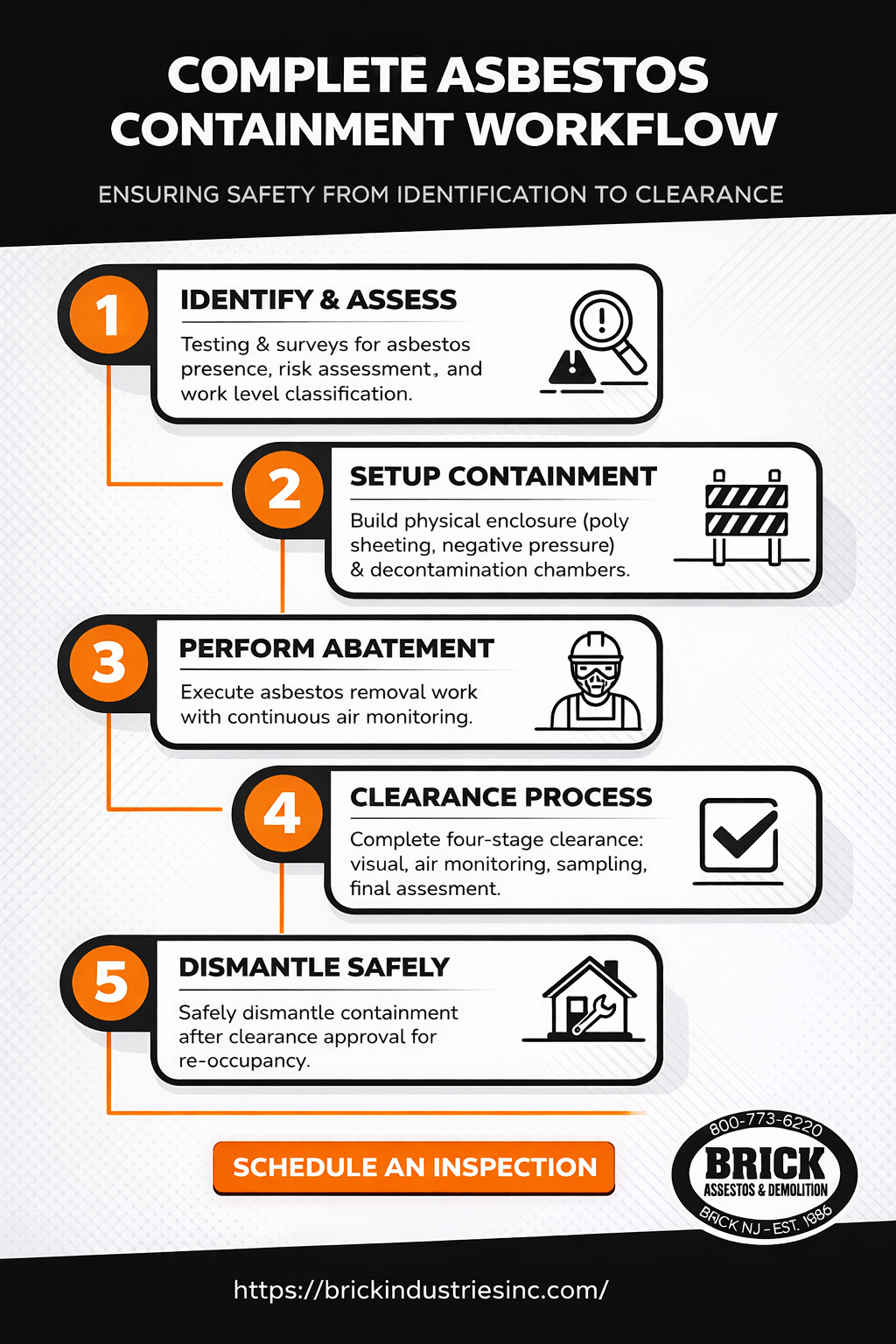
The Anatomy of a Safe Asbestos Containment and Enclosure
This section details the essential physical barriers and engineering controls that create a secure work environment, preventing the spread of hazardous asbestos fibers.
Essential Components of Asbestos Containment and Enclosure
When we start on an asbestos removal project in New Jersey, New York, or Pennsylvania, our first priority is to establish a robust Asbestos Containment and Enclosure. This physical barrier is designed to completely isolate the work area, ensuring that no hazardous asbestos fibers escape into the surrounding environment.
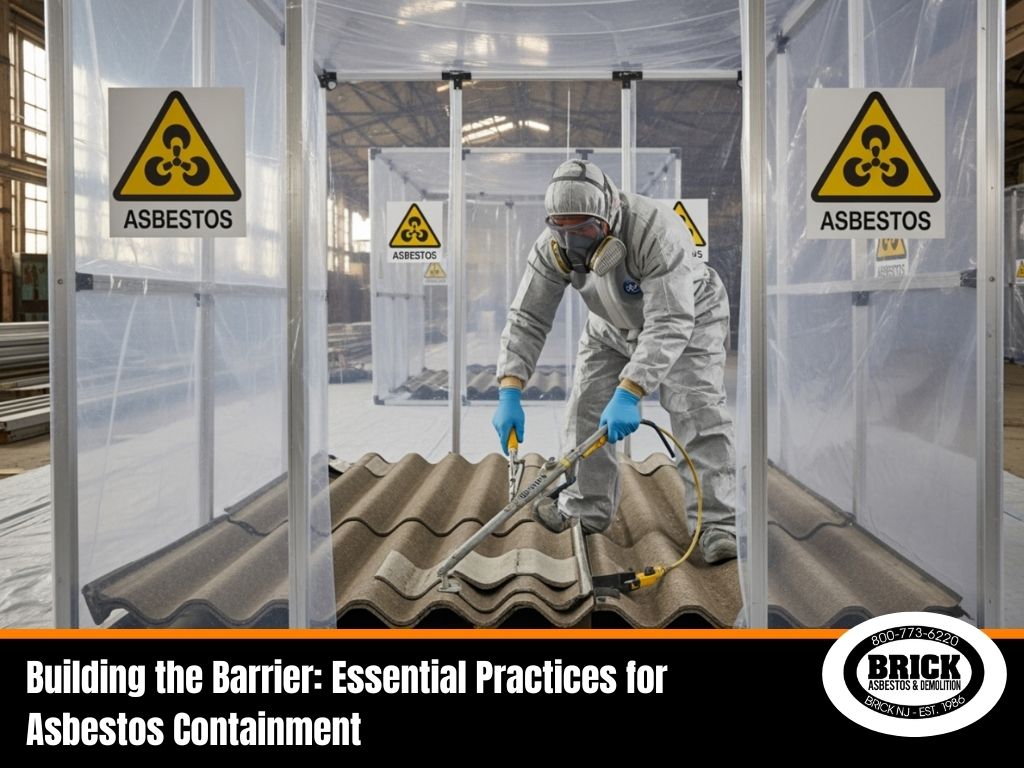
The foundation of any effective containment is the use of heavy-duty polyethylene sheeting. We typically use a minimum of 6-mil thick poly sheeting for walls, floors, and any fixtures within the work zone. This durable plastic creates a sealed environment, preventing the release of fibers. Every seam, every edge, and every penetration point must be carefully sealed with specialized tape to achieve an airtight barrier. This isn’t just about covering surfaces; it’s about creating a truly impermeable envelope around the asbestos-containing material.
Within this sealed environment, we often construct a scaffolding framework. This provides the structural integrity needed to support the poly sheeting and any other equipment, ensuring the enclosure remains stable throughout the abatement process. For monitoring purposes, viewing panels made of clear plastic are strategically placed, allowing supervisors and air monitoring personnel to observe the work without compromising the containment.
Crucially, clear and prominent warning signage is posted at all entry points to the containment area. These “Danger Asbestos” signs serve as a critical alert, preventing unauthorized personnel from entering the hazardous zone. If you ever see such a sign, our advice is simple: do not enter. This is a regulated area with serious health risks. Our practices strictly adhere to NJ Asbestos Regulations and applicable federal and state guidelines, ensuring every component meets the highest safety standards.
Negative Pressure and Air Filtration
Once the physical barriers are in place, the next critical step in establishing a safe Asbestos Containment and Enclosure is implementing negative air pressure and advanced air filtration. This is where our unsung heroes, the negative air machines, come into play.
A negative air machine, equipped with high-efficiency particulate air (HEPA) filters, serves two vital functions. Firstly, it continuously draws air from within the containment area, filtering out airborne asbestos fibers. These HEPA filters are remarkable, capable of trapping 99.97% of particles that are 0.3 microns or larger – precisely the size of dangerous asbestos fibers. Secondly, and equally important, these machines create a negative pressure environment inside the enclosure.
The concept of negative pressure is straightforward yet ingenious: it means the air pressure inside the containment area is slightly lower than the pressure outside. This ensures that if there are any tiny breaches or imperfections in our airtight seals, air will always flow into the containment area, rather than allowing asbestos fibers to escape out into clean areas. It’s like a vacuum effect, keeping all the nastiness locked down.
To continuously monitor and verify this critical negative pressure, we use manometers. These small, precise testing devices measure minute air pressure changes, providing real-time data to our on-site supervisors. A typical requirement is to maintain a negative air pressure of at least 0.02 inches of water relative to the outside environment. This constant monitoring ensures the integrity of the containment, giving us immediate feedback if any adjustments are needed. Without this vigilant oversight, even the best physical enclosure could fail to prevent Asbestos Contamination.
Decontamination Chambers: The Safe Gateway
The decontamination chamber is a non-negotiable component of any safe Asbestos Containment and Enclosure. Think of it as the airlock that protects the outside world from the hazardous interior. Its purpose is to ensure that no asbestos fibers are carried out of the work area by personnel or equipment, preventing cross-contamination and protecting everyone involved.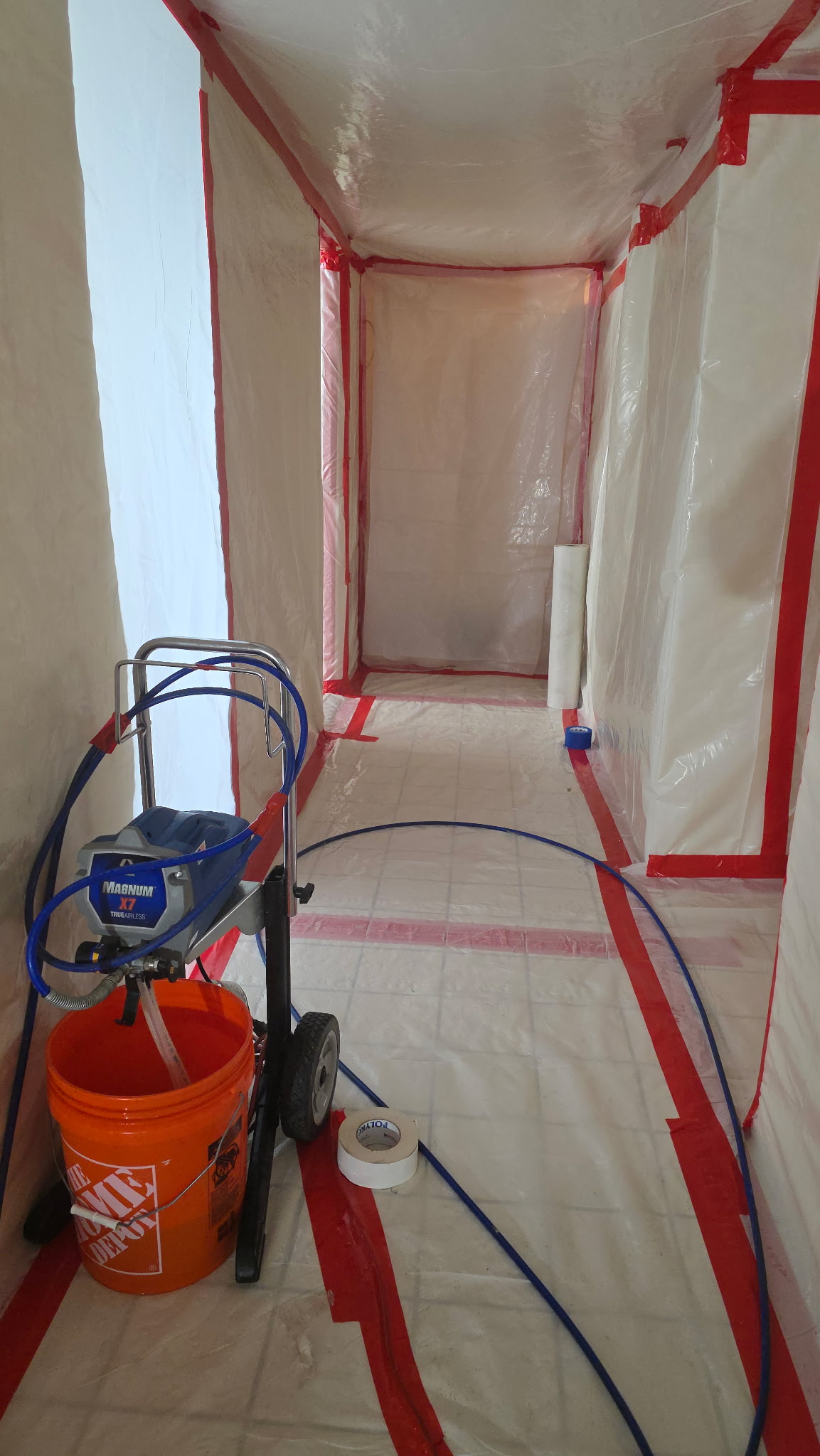
A standard decontamination chamber is a three-stage system, comprising three interconnected rooms:
- Dirty/Equipment Room: This is the first room workers enter when exiting the main work area. Here, gross contamination is removed from tools, equipment, and personal protective equipment (PPE). Workers will carefully remove their outer layer of PPE, such as disposable coveralls, and place them into designated asbestos waste bags. Any visible dust is typically wet-wiped or HEPA-vacuumed from reusable equipment.
- Shower Room: After shedding their initial layer of contaminated gear, workers proceed to the shower room. Here, they take a thorough shower, often with warm water between 40° and 50° Celsius, to wash off any remaining asbestos fibers from their bodies and hair. This step is crucial for preventing the spread of fibers.
- Clean Room: The final stage is the clean room. After showering, workers enter this room to dry off and put on clean clothing. This room is maintained as a fiber-free zone, ensuring that personnel are completely decontaminated before re-entering uncontaminated areas.
Doorways between these rooms are typically equipped with overlapping plastic curtains to minimize air movement and prevent fiber migration. This meticulous process is a cornerstone of worker hygiene protocols and is vital for preventing the spread of asbestos fibers beyond the containment area, whether we’re working on a residential project or a large-scale commercial Asbestos Removal Toms River NJ.
Tailoring Containment to the Task: Risk Levels and Methods
Not all asbestos work is the same. The level of risk dictates the type and scale of containment required, from minor repairs to large-scale abatement projects.
Understanding Asbestos Work Levels
The intensity and potential for fiber release from asbestos-containing materials (ACM) vary greatly, which means our Asbestos Containment and Enclosure strategies must be adaptable. Regulations in New Jersey, New York, and Pennsylvania, mirroring federal guidelines, categorize asbestos work into different levels, often referred to as Type 1, Type 2, and Type 3 operations, or low, moderate, and high risk.
The primary factor determining the risk level is whether the ACM is friable or non-friable. Friable ACM is material that can be easily crumbled, pulverized, or reduced to powder by hand pressure when dry. This type of material, like sprayed-on insulation or pipe lagging, poses a much higher risk of fiber release and thus requires the most stringent containment. Non-friable ACM, such as asbestos floor tiles or cement sheets, has fibers bound in a matrix and is less likely to release fibers unless severely damaged or subjected to aggressive disturbance.
- Type 1 (Low-Risk) Operations: These typically involve very small, non-friable amounts of ACM where disturbance is minimal, such as the removal of a small section of non-friable floor tile. Containment might involve simply isolating the area with plastic sheeting and using wet methods.
- Type 2 (Moderate-Risk) Operations: This category includes larger amounts of non-friable ACM, or small amounts of friable ACM, where there’s a higher potential for fiber release, such as removing ceiling tiles or working with glove bags on pipe insulation. More extensive containment, including critical barriers and mini-enclosures, along with negative air, may be necessary.
- Type 3 (High-Risk) Operations: These are the most hazardous, involving large quantities of friable ACM or activities with a high potential for significant fiber release, such as the removal of sprayed-on fireproofing or extensive pipe insulation. These operations mandate full, airtight Asbestos Containment and Enclosure with negative air pressure, decontamination chambers, and continuous air monitoring.
For Type 2 and Type 3 operations, specialized training and certification for workers are essential. Personnel working with or around these enclosures must be adequately trained in safe work procedures, respirator use, and decontamination protocols. This distinction also influences whether the work is considered “licensed” (requiring specialized contractors like us) or “non-licensed” (for smaller, lower-risk tasks by trained maintenance staff). Our team at Brick Asbestos and Demolition is fully trained and certified to handle all levels of Asbestos Removal across our service areas.
Specialized Techniques: The Glove Bag Method
While full-scale Asbestos Containment and Enclosure is crucial for large-area removals, some situations call for a more localized approach. This is where the glove bag method shines as an ingenious specialized technique.
The glove bag method involves using a pre-fabricated, heavy-duty plastic bag that is sealed directly around the section of asbestos-containing material to be removed, most commonly pipe insulation or ducting wraps. The bag is equipped with built-in gloves, allowing a trained worker to perform the removal task from outside the sealed bag, directly manipulating tools and the asbestos material within the contained environment.
This method is particularly effective for small, linear sections of pipe or ductwork where constructing a large, room-sized enclosure would be impractical, excessively costly, or disruptive. It provides immediate, localized containment, preventing fibers from becoming airborne and spreading through the building.
Before starting, the glove bag is securely sealed around the pipe, often with tape. A wetting agent is introduced into the bag to suppress dust, and then the worker carefully removes the asbestos material. Once the material is removed and placed within the bottom of the bag, the bag is sealed off, removed, and disposed of as asbestos waste. This allows for safe removal of pipe and ducting tape or wrap without covering the entire room in containment, making it a highly efficient and safe method for specific tasks. Our expertise ensures proper execution of the glove bag method for targeted Asbestos Removal Colts Neck NJ and similar projects.
Navigating the Regulatory Maze
Strict government regulations are in place to protect workers and the public. Compliance is not optional; it’s a legal and ethical necessity.
US, UK, and Canadian Regulatory Standards for Asbestos Containment and Enclosure
The robust framework for Asbestos Containment and Enclosure is not just a set of best practices; it’s mandated by comprehensive legal and regulatory requirements. In our service areas of New Jersey, New York, and Pennsylvania, we rigorously adhere to federal regulations set by the Occupational Safety and Health Administration (OSHA) and the Environmental Protection Agency (EPA), as well as specific state and local requirements.
OSHA regulations, particularly 29 CFR 1926.1101, establish strict standards for worker protection during asbestos-related activities. This includes permissible exposure limits (PELs) for asbestos fibers in the air. The current PEL for asbestos is 0.1 fibers per cubic centimeter (f/cc) as an 8-hour time-weighted average (TWA), with an excursion limit of 1.0 f/cc averaged over 30 minutes. These regulations dictate the need for engineering controls like containment, personal protective equipment (PPE), medical surveillance, and training. You can find more detailed information on these critical standards by choosing to Read the OSHA regulations.
The EPA, through regulations like the National Emission Standards for Hazardous Air Pollutants (NESHAP) for asbestos (40 CFR Part 61, Subpart M), governs demolition and renovation activities involving asbestos. These regulations focus on preventing the release of asbestos fibers into the ambient air, requiring proper notification, work practices, and disposal procedures.
While our primary focus is on compliance within the United States, it’s worth noting that other nations also have stringent regulations. For instance, the UK’s Control of Asbestos Regulations 2012 (CAR 2012) provides detailed guidance for managing and working with asbestos, emphasizing enclosures for licensable work and mandating a “duty to manage” asbestos in non-domestic premises. Further in-depth information on the key features of an effective asbestos enclosure can be found in the HSE’s free-to-download Asbestos: The licensed contractors’ guide (HSG247). Similarly, Canada’s Labour Code and provincial regulations outline specific requirements for asbestos exposure management programs, including detailed specifications for containment and worker protection.
These regulations, whether federal, state, or international, underscore a universal truth: the safe handling of asbestos is a legal and ethical imperative. Our commitment at Brick Asbestos and Demolition is to ensure every project, from a small residential job to a large commercial Asbestos Removal Princeton NJ, meets or exceeds all applicable standards, protecting both our team and the community.
The Final Hurdle: Safe Dismantling and Clearance
Once the asbestos is removed, the job isn’t over. The containment area itself must be carefully cleaned and tested before it can be safely dismantled.
The Four-Stage Clearance Process
After the physical removal of asbestos-containing materials is complete within the Asbestos Containment and Enclosure, our work shifts to ensuring the area is truly clean and safe for re-occupancy. This crucial phase is governed by a rigorous four-stage clearance process:
- Stage 1: Preliminary Check (Visual Inspection within the Enclosure): Our certified supervisors conduct a thorough visual inspection inside the containment area. They carefully check all surfaces for any visible dust, debris, or residue that might contain asbestos. This initial check confirms that the abatement work itself has been completed to a high standard of cleanliness.
- Stage 2: Thorough Visual Inspection (by Independent Analyst): An independent, qualified analyst performs a second, more critical visual inspection. This objective assessment ensures that all visible signs of asbestos have been removed and that the area is clean. If any dust or debris is found, the area must be recleaned, and this stage repeated.
- Stage 3: Clearance Air Sampling: This is arguably the most critical stage. Air sampling devices are strategically placed within the containment area to collect air samples. To ensure any settled fibers are dislodged and captured, aggressive air sampling techniques are often employed, which might involve using leaf blowers or fans to disturb surfaces immediately before sampling. These air samples are then sent to an accredited laboratory for analysis. The results must demonstrate that airborne asbestos fiber concentrations are below the strict regulatory clearance limits (often 0.01 f/cc or less in the US, depending on local regulations) before the area can proceed. These tests tell us if there are safe levels of fibers in the air. If the fiber levels are high, this tells us the negative air isn’t functioning as well as it should be and the issue needs addressing. These tests are also used once a project is completed to tell us the building is safe for occupancy.
- Stage 4: Final Assessment and Certificate of Reoccupation: Once all visual inspections are passed and air sampling results confirm the area is clean, the independent analyst issues a certificate of reoccupation. This document officially declares the area safe for dismantling the containment and for re-entry by building occupants.
This multi-faceted clearance process is our guarantee that our Asbestos Removal Middletown NJ projects, and all others, are not just completed, but completed safely and responsibly.
Safely Tearing Down the Enclosure
Dismantling an Asbestos Containment and Enclosure is not a casual task; it’s a carefully orchestrated procedure that must follow the successful completion of the four-stage clearance process. Even after an area has been cleared, residual fibers can remain on the surfaces of the poly sheeting and other containment materials.
Our procedure for safely tearing down the enclosure includes:
- Wetting Down Surfaces: Before any plastic sheeting is disturbed, all internal surfaces of the containment, especially the poly sheeting, are thoroughly wetted down with an amended water solution. This suppresses any remaining fibers and prevents them from becoming airborne during the dismantling process.
- HEPA Vacuuming: Any tools or reusable equipment that were inside the containment are carefully HEPA-vacuumed or wet-wiped before being removed.
- Controlled Removal of Sheeting: The poly sheeting is carefully removed, rolled inward to encapsulate any potential fibers, and immediately placed into clearly marked, impervious asbestos waste bags. These bags are then sealed and prepared for proper disposal according to federal, state, and local hazardous waste regulations.
- Continued PPE Use: Personnel involved in dismantling the enclosure continue to wear appropriate personal protective equipment (PPE), including respirators, until all contaminated materials are bagged and the area is confirmed clean.
- Final Cleanup: After the enclosure is fully dismantled, a final thorough cleaning of the area is performed using HEPA vacuums and wet mopping techniques.
This meticulous approach ensures that the entire process, from initial setup to final tear-down, prioritizes safety and prevents any potential for asbestos exposure. It’s an integral part of our comprehensive Enviro-Safe Interior Demolition services.
Frequently Asked Questions about Asbestos Containment
What is the difference between asbestos enclosure and encapsulation?
While both are methods for managing asbestos-containing materials (ACM), Asbestos Containment and Enclosure involves building a physical, airtight barrier around the asbestos material or the work area. This creates a separate, controlled environment to prevent fiber release during disturbance (e.g., during removal). Encapsulation, on the other hand, involves applying a sealant or coating directly onto the surface of the asbestos material. This binds the fibers together or creates a protective layer over them, preventing their release. Enclosure is a form of containment, often temporary for removal, while encapsulation is a repair method that leaves the asbestos in place.
Can I enter an asbestos containment area?
No. Absolutely not. Asbestos containment areas are strictly regulated and are considered hazardous environments. They are clearly marked with “Danger Asbestos” warning signs for a critical reason. Only trained, authorized, and properly equipped personnel, wearing the correct personal protective equipment (PPE), including respirators, are permitted to enter these designated work zones. Unauthorized entry could lead to severe asbestos exposure and pose significant health risks. If you see an asbestos danger sign, it is imperative that you do not enter the area.
How long does an asbestos containment setup stay in place?
The Asbestos Containment and Enclosure remains in place for the entire duration of the asbestos removal or repair work. It is only dismantled after the area has successfully passed a rigorous, multi-stage clearance process. This typically includes thorough visual inspections by independent analysts and, crucially, clearance air testing. These air tests confirm that airborne asbestos fiber levels are below regulatory limits, verifying that the area is safe for re-occupancy. Until this final clearance certificate is issued, the containment must remain intact to protect building occupants and workers.
Your Partner in Safe Asbestos Abatement
Proper Asbestos Containment and Enclosure are non-negotiable for protecting the health of building occupants and workers. From the initial setup with sealed poly sheeting and negative air machines to the final clearance air testing, every step is a critical part of a complex safety system. This process demands expertise, precision, and strict adherence to regulations. For professional and compliant asbestos abatement services in New Jersey, New York, and Pennsylvania, trust the experts at Brick Asbestos and Demolition to build the barrier that ensures your safety. Our four decades of experience mean we understand the nuances of safe and effective asbestos management. Learn more about our comprehensive abatement process.

Recent Articles
From Foundation to Dust: Your Complete Guide to Building Demolition
Steel Demolition: Techniques, Safety, and What You Need to Know