

Your Local Demolition Hero: A Guide to Finding Top Selective Contractors

Why Finding the Right Selective Demolition Contractor Matters
A selective demolition contractor near me is a specialized professional who removes specific parts of a structure while preserving the rest—essential for renovations, additions, hazardous material removal, and historic preservation projects. Unlike complete demolition, selective demolition requires surgical precision, advanced planning, and strict safety protocols to protect both workers and the remaining structure.
What to look for when choosing a selective demolition contractor:
- Valid licenses and insurance (EPA, OSHA, state-specific certifications)
- Hazardous material abatement certification (especially for asbestos and lead)
- Proven safety record with measurable metrics (EMR, TRIR)
- Specialized equipment for precision removal and dust control
- Local regulatory knowledge for NJ, NY, or PA compliance
- Clear project management approach with timelines and communication plans
- Portfolio of similar projects in your property type
- Transparent pricing with detailed estimates and no hidden fees
Demolition isn’t just about knocking everything down and starting from scratch. When you need to remove a wall, gut an interior space, or strip out hazardous materials while keeping the rest of your building intact, you need a contractor who understands the art of selective removal.
Think of it like surgery versus amputation. A complete demolition crew might excel at total teardowns, but selective demolition requires a different skill set entirely. You’re working around occupied spaces, preserving structural elements, managing hazardous materials, and coordinating with other trades—all while maintaining strict safety standards.
The stakes are high. Choose the wrong contractor and you risk:
- Structural damage to parts you wanted to keep
- Dangerous exposure to asbestos or lead
- Project delays that cascade through your entire timeline
- Excessive dust and noise disrupting nearby tenants or operations
- Regulatory violations and costly fines
- Unexpected costs from improper planning
Choose the right contractor and you get a clean slate, ready for the next phase, with zero surprises.
As Eric Plackis, President of Brick Industries with 40+ years of experience, I’ve guided hundreds of property owners through complex selective demolition projects across New Jersey, New York, and Pennsylvania. Whether you’re searching for a selective demolition contractor near me for a commercial renovation, historic preservation, or hazardous material removal, understanding what separates exceptional contractors from mediocre ones will save you time, money, and headaches.
The Art of Surgical Removal: Understanding Selective Demolition
Selective demolition is a precise science: removing only targeted parts of a building while keeping the rest structurally sound. It is closer to surgical removal than to wholesale teardown, demanding careful planning, engineering, and coordination with other trades.
Compared to complete demolition, which eliminates an entire structure, selective demolition focuses on preserving structural integrity and specific components. It often overlaps with deconstruction in its meticulous nature, but the primary goal is usually to support renovation or repurposing rather than maximizing material salvage. Every project requires a detailed plan so that only the intended areas are affected.
When to Choose Precision Over Wreckage
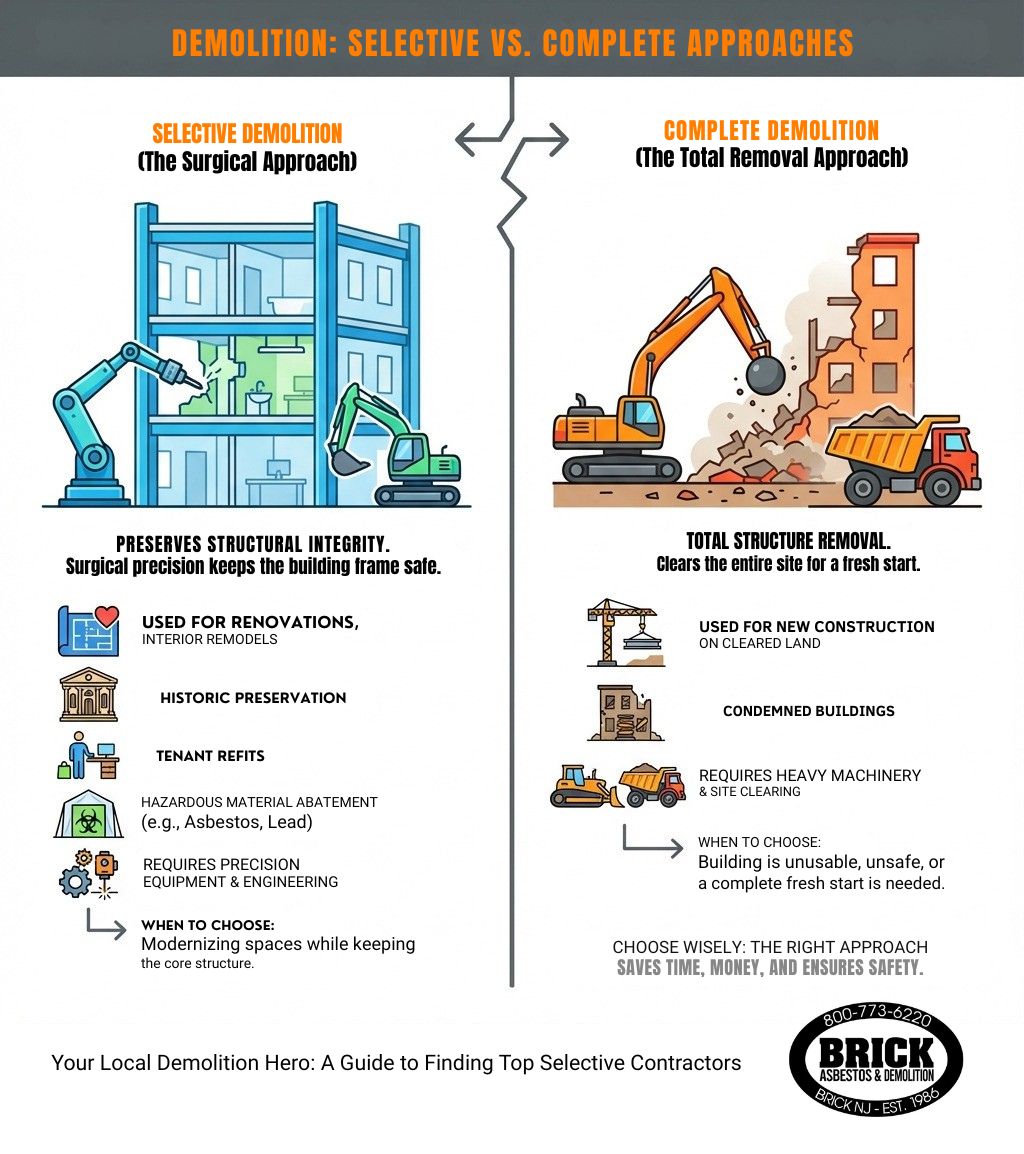
Selective demolition is the right choice when a building is fundamentally sound but needs substantial modification. It lets you keep the bones of the structure while changing interiors or specific sections.
Common situations where precision is the better option include:
- Interior remodels and renovations: In homes, offices, and retail spaces, selective demolition makes it possible to remove specific walls, flooring (VCT, LVT, tile, carpet), ceilings (acoustical, GWB), millwork, or fixtures without disturbing adjacent areas. This is critical when neighboring spaces are occupied. We offer expert Interior Demolition services custom to your project.
- Historic preservation: For landmarks and heritage buildings, selective deconstruction allows removal of non-historic or deteriorated elements while preserving historic facades and architectural details so the character of the building remains intact.
- Building extensions: When adding a new wing or expanding a section, selective demolition prepares tie‑in points and interfaces so the new work integrates seamlessly with the original structure.
- Tenant refits: In commercial properties, tenant refit demolition prepares spaces for new occupants by removing existing finishes and systems, often in medical, commercial, and industrial facilities that may still be occupied.
- Asbestos abatement and hazardous material removal: Many older properties in NJ, NY, and PA contain asbestos, lead paint, or mold. Selective demolition is frequently combined with environmental abatement to safely remove these materials before broader renovation or demolition proceeds.
- Façade preservation: Sometimes only the exterior shell must remain while the interior is fully gutted for a new build‑out. Selective demolition makes this possible without compromising the façade.
- Plant decommissioning: In industrial settings, specific machinery, process lines, or portions of a plant can be dismantled while other operations continue or the site is prepared for new equipment.
Ideal projects where selective demolition excels include:
- Commercial space gut‑outs for new retail or office layouts
- Hospital renovations around sensitive equipment and patient areas
- Heritage building restoration where key structural elements must be preserved
- Industrial equipment removal from active manufacturing plants
- Demolition within schools or universities scheduled to minimize disruption
The Blueprint for Success: Key Steps in the Process
Every successful selective demolition project starts long before any physical work. It follows a structured process that prioritizes safety, control, and efficiency.

- Thorough Surveying and Planning: The first step is identifying exactly what must be removed and how to access it. This includes reviewing structural components, utilities, access routes, and the surrounding environment, and flagging any site‑specific risks.
- Engineering and Sequencing: A detailed plan outlines the order of operations, temporary supports that may be needed, and the specialized tools required. Proper sequencing is what keeps the remaining structure stable while work progresses.
- Hazard Analysis and Environmental Assessment: Before demolition begins, potential hazards and environmental impacts are evaluated, including testing for asbestos, lead, and other regulated materials.
- Safe Hazardous Material Abatement: If hazardous materials are found, certified teams remove and dispose of them in compliance with regulations before primary demolition starts, protecting workers, occupants, and the environment.
- Precision Removal with Specialized Equipment: Using the right equipment, trained crews remove targeted building components while minimizing vibration, noise, and dust. Our in‑house OSHA‑trained dismantlers are experienced in working in occupied buildings.
- Material Salvaging and Waste Reduction: Whenever feasible, materials are separated for recycling or reuse, reducing disposal volumes and potentially offsetting project costs.
- Debris Removal and Site Cleanup: After demolition is complete, debris is removed and the site is thoroughly cleaned so it is safe and ready for the next phase of construction as part of our comprehensive Demolition services.
How to Find the Best Selective Demolition Contractor Near Me
Finding the right selective demolition contractor near me in NJ, NY, or PA is critical to your project’s success. You are not just hiring someone to remove materials; you are choosing a partner who understands precision work, safety, and local requirements.
Start by focusing on local expertise. Regulations for demolition, hazardous material abatement, and waste disposal vary between municipalities in New Jersey, New York, and Pennsylvania. A contractor with deep regional experience will know which permits are required, how inspections work, and what each town expects.
Strong project management is equally important. Your contractor should clearly explain timelines, staffing, and communication. They should outline how they will minimize disruption in occupied buildings or dense neighborhoods, including specific strategies for dust control and sound mitigation. We pride ourselves on maintaining clear communication with clients, architects, and contractors throughout every project so the process remains predictable.
Essential Qualifications: What to Look for in a Pro
When you’re trusting a contractor with selective demolition, certain qualifications are non‑negotiable.
Here’s a table outlining key criteria to review:
| Qualification Category | What to Look For |
|---|---|
| Licenses & Insurance | Fully licensed and insured in your state (NJ, NY, PA). Request proof of general liability and workers’ compensation. |
| Certifications | OSHA safety training for crew members and EPA certification for handling hazardous materials such as asbestos and lead. |
| Experience & Portfolio | A proven track record on projects similar to yours. Ask for a portfolio and references. A company with decades of experience, like Brick Industries, brings invaluable knowledge to complex Commercial Demolition projects. |
| Safety Record | Ask about safety metrics such as Experience Modification Rate (EMR) and Total Recordable Incident Rate (TRIR). A low EMR (below 1.0) is a strong indicator of a solid safety culture. Look for companies recognized for excellence and best practice in the industry. |
| Specialized Equipment | Access to the right tools, including robotic demolition machines for tight spaces, HEPA‑filtered air scrubbers for dust control, and precision cutting tools. |
The Benefits of Hiring an Expert Selective Demolition Contractor Near Me

Choosing a professional team is not only about avoiding problems; it can significantly improve project outcomes:
- Safety and Compliance: An expert contractor steers OSHA and EPA requirements, keeping your site compliant and reducing the risk of fines, particularly when asbestos or other hazardous materials are involved.
- Efficiency and Speed: Experienced crews equipped with specialized tools can complete work more quickly and with fewer disruptions than a general contractor handling demolition on the side.
- Cost‑Effectiveness: Avoiding structural damage, unplanned change orders, and disposal inefficiencies can save substantial money over the life of the project.
- Environmental Responsibility: Reputable contractors prioritize recycling, proper disposal, and material separation, lowering environmental impact and sometimes generating savings.
- Asset Recovery: On industrial or commercial jobs, an experienced Demolition contractor can identify materials and equipment with resale value, helping offset demolition costs.
Key Questions to Ask a Potential Selective Demolition Contractor Near Me
Before signing a contract, ask focused questions to assess expertise and fit:
- What is your safety record, and what specific safety protocols will you implement on my project?
- How do you control dust, noise, and debris, especially in occupied buildings?
- Are you licensed and certified to handle hazardous materials such as asbestos and lead?
- Can you provide a detailed project timeline, and how do you manage potential delays?
- What is your process for debris removal, recycling, and documentation of disposal?
- Can you show examples of similar projects you have completed in my building type?
- What does your insurance cover, and can you provide a current certificate of insurance?
- Who will be my main point of contact during the project, and how often will I receive updates?
- How do you handle permitting with local municipalities and required inspections?
These questions help distinguish true specialists from less qualified bidders. At Brick Industries, we welcome this level of due diligence and provide clear, detailed answers. Our Enviro Safe Interior Demolition services are designed to address these concerns from day one.
Finalizing Your Choice and Starting Your Project
After reviewing your options, the final step toward a successful selective demolition project is confirming your contractor and launching the work. This is where careful planning turns into on-site execution, backed by clear expectations on both sides.
Reviewing Quotes and Contracts
Before you commit, examine all quotes and contracts in detail. Make sure the scope of work, schedule, safety measures, and debris disposal approach are clearly spelled out. Look for transparent pricing and itemized services so you understand what is and is not included. A professional contractor, like Brick Asbestos & Demolition, will provide a detailed estimate that considers hazardous material abatement, permitting, and final site cleanup. Ask for clarification on anything that is unclear.
Understanding the Agreement
Your contract should define each party’s responsibilities, including payment terms, insurance requirements, and how communication will be handled. It should also explain how unforeseen conditions, scope changes, or schedule shifts will be managed. Confirm that the contractor’s general liability and workers’ compensation coverage are in place to protect you from potential liabilities.
Project Kickoff and Communication
Once the agreement is signed, the project can officially begin. Successful selective demolition relies on consistent communication. Your contractor should identify your primary point of contact, outline how often you will receive updates, and specify whether information will be shared via phone, email, or on-site meetings.
At Brick Asbestos & Demolition, our project managers keep clients informed about progress, any issues that arise, and the plan to address them. This proactive approach helps keep the work on schedule and minimizes surprises.
Trusting Your Partner
Choosing a selective demolition contractor near me is ultimately about trust and expertise. With four decades of experience across NJ, NY, and PA, our family-owned business is committed to delivering safe, compliant, and efficient selective demolition. We combine modern technology with knowledge of local regulations and extend special offers to veterans, seniors, and new customers.
We are ready to help you create a clean, safe starting point for your renovation or restoration.
Ready to discuss your selective demolition needs? Contact us for your selective demolition needs today and let our expertise work for you.

Recent Articles
What Happens to Concrete After Demolition? Recycling, Reuse, and Disposal in NJ
Cheat Sheet to Identifying Asbestos in Insulation