

3 Reliable Ways to Hire a Licensed Asbestos Inspector in Ocean County, NJ

Why Asbestos Testing in Ocean County Matters for Your Property
Asbestos testing in Ocean County is essential for anyone planning renovations, demolitions, or property sales. To find qualified services quickly:
- Contact the NJ Department of Health for certified inspectors and labs.
- Check local asbestos abatement contractors for licensing, insurance, and NJDEP compliance.
- Verify AHERA certification for schools and NVLAP accreditation for labs.
Many of Ocean County’s homes and buildings were built before the late 1980s, when asbestos was a common construction material. If your property dates to the 1950s or earlier, it likely contains asbestos in ceiling tiles, pipe insulation, vinyl flooring, or siding.
Asbestos is a mineral fiber once valued for its durability and heat resistance. When materials containing it are damaged or disturbed, they release microscopic fibers. Breathing these fibers can lead to serious health conditions, including:
- Mesothelioma (a rare, aggressive cancer)
- Lung cancer
- Asbestosis (scarring of lung tissue)
Asbestos-related diseases can take decades to develop. While older adults with occupational exposure are at high risk, anyone can be affected during home renovations. You can learn more about these risks and other scientific research on risk factors.
When should you test for asbestos?
Professional testing is needed before:
- Renovations or remodeling
- Demolition projects
- Property sales
- Repairs to damaged materials in pre-1990 buildings
Federal regulations require an asbestos inspection for pre-1991 structures undergoing demolition or renovation. Since you can’t identify asbestos by sight, laboratory analysis is necessary.
This guide outlines the steps to locate and verify independent, certified asbestos testing professionals in Ocean County. If you have already confirmed the presence of hazardous materials and require professional abatement, please see our dedicated service pages for Asbestos Removal in Toms River, NJ and Asbestos Removal in Brick, NJ, or view our core Asbestos Testing capabilities.
How to Identify a Qualified Inspector
Finding reliable asbestos testing services in Ocean County doesn’t have to be daunting. The priority is always safety and compliance. You need a trustworthy partner who provides clear answers and understands the specific requirements of New Jersey.
Reliable testing is a comprehensive approach that includes proper certification, adherence to state requirements, and local expertise. To ensure an unbiased assessment, your testing professional should be separate from any abatement services. Our goal is to empower you with the knowledge to make informed decisions for your property.
1. Use Official State and County Resources
A smart first step for asbestos testing is to consult official state and local resources. The New Jersey Department of Health (NJDOH) is a key resource, providing lists of certified training agencies and accredited laboratories. This ensures any professional you hire meets rigorous state standards. Find more on their Department of Health | Environmental Health page.
Proper disposal is also critical. The Ocean County Landfill in Manchester Township is the designated facility for asbestos-containing materials. Understanding disposal requirements is part of the overall management process. Resources like Handling Asbestos can offer guidance.
Common Asbestos-Containing Materials in Ocean County Homes
Due to the age of many properties in Ocean County, asbestos is likely present in homes built before the late 1980s. Common materials include:
- Vinyl floor tiles: And the mastic used to adhere them.
- Popcorn ceilings (Acoustic ceilings): Popular from the 1950s to 1980s.
- Pipe and boiler insulation: Often found in basements and utility rooms.
- Roofing and siding shingles: Used for strength and fire resistance.
- Plaster and joint compounds: Added for strength.
- Ductwork insulation: Wrapped around heating and cooling ducts.
- Attic insulation: Especially vermiculite insulation.
- Artificial materials in gas fireplaces: For heat resistance.
Intact asbestos materials pose a low risk, but the danger arises when they are damaged or disturbed, releasing fibers. This is why professional asbestos testing is vital in Ocean County before any project.
2. Vet Local Companies for Experience and Compliance
After consulting state resources, vet local companies for reliable asbestos testing in Ocean County. Look for a partner with a proven track record who prioritizes safety and regulatory compliance.
When evaluating services, look for these key indicators:
- Licensed and Insured: Ensure the company is licensed by the NJ Department of Labor and Workforce Development (DOLWD) and carries proper insurance for your protection.
- AHERA Certification: For schools and public buildings, professionals must have AHERA (Asbestos Hazard Emergency Response Act) certification.
- NJDEP and OSHA Compliance: A reputable company will follow all NJ Department of Environmental Protection (NJDEP) and Occupational Safety and Health Administration (OSHA) regulations.
- Lab Accreditation (NVLAP): The lab analyzing samples must be accredited by a program like the National Voluntary Laboratory Accreditation Program (NVLAP) for accuracy.
- Experience and Reviews: Look for companies with a long history and positive customer reviews that demonstrate expertise and professionalism.
- Ask Questions: Inquire about their licensing, insurance, project experience, and testing methods. A transparent company will provide detailed answers.
Choosing a certified company prevents issues related to Asbestos Contamination and ensures work is done safely and legally. Our team provides thorough, compliant services throughout Ocean County.
3. Understand the Inspection Process and Costs
Understanding the process for asbestos testing can help you feel more prepared. Here’s what to expect.

The Asbestos Testing Process
The process generally involves these steps:
- Initial Consultation: A certified inspector discusses your concerns, reviews the property’s history, and performs a visual inspection to identify suspect materials.
- Sample Collection: Licensed professionals safely collect small samples from suspect materials, following strict protocols to prevent fiber release.
- Laboratory Analysis (PLM): Samples are sent to an accredited lab for analysis, typically using Polarized Light Microscopy (PLM) to identify the type and percentage of asbestos.
- Turnaround Time: Reports are usually available within 24–72 hours, depending on the number of samples and lab workload.
- Detailed Report: You receive a comprehensive report stating whether asbestos is present, its type, and concentration, along with expert recommendations for management or abatement.
Factors Influencing Costs
The cost of asbestos testing in Ocean County is influenced by:
- Property Size and Accessibility: Larger or hard-to-reach properties may require more time and labor.
- Number of Samples: Each sample taken and analyzed incurs a lab fee.
- Scope of Inspection: A full pre-renovation survey costs more than testing a few specific materials.
- Urgency: Expedited lab services are available for an additional fee.
A transparent quote should include the inspector’s time, sample collection, lab fees, and the final report. For more information, visit our Asbestos Testing page.
Interpreting Your Laboratory Test Results
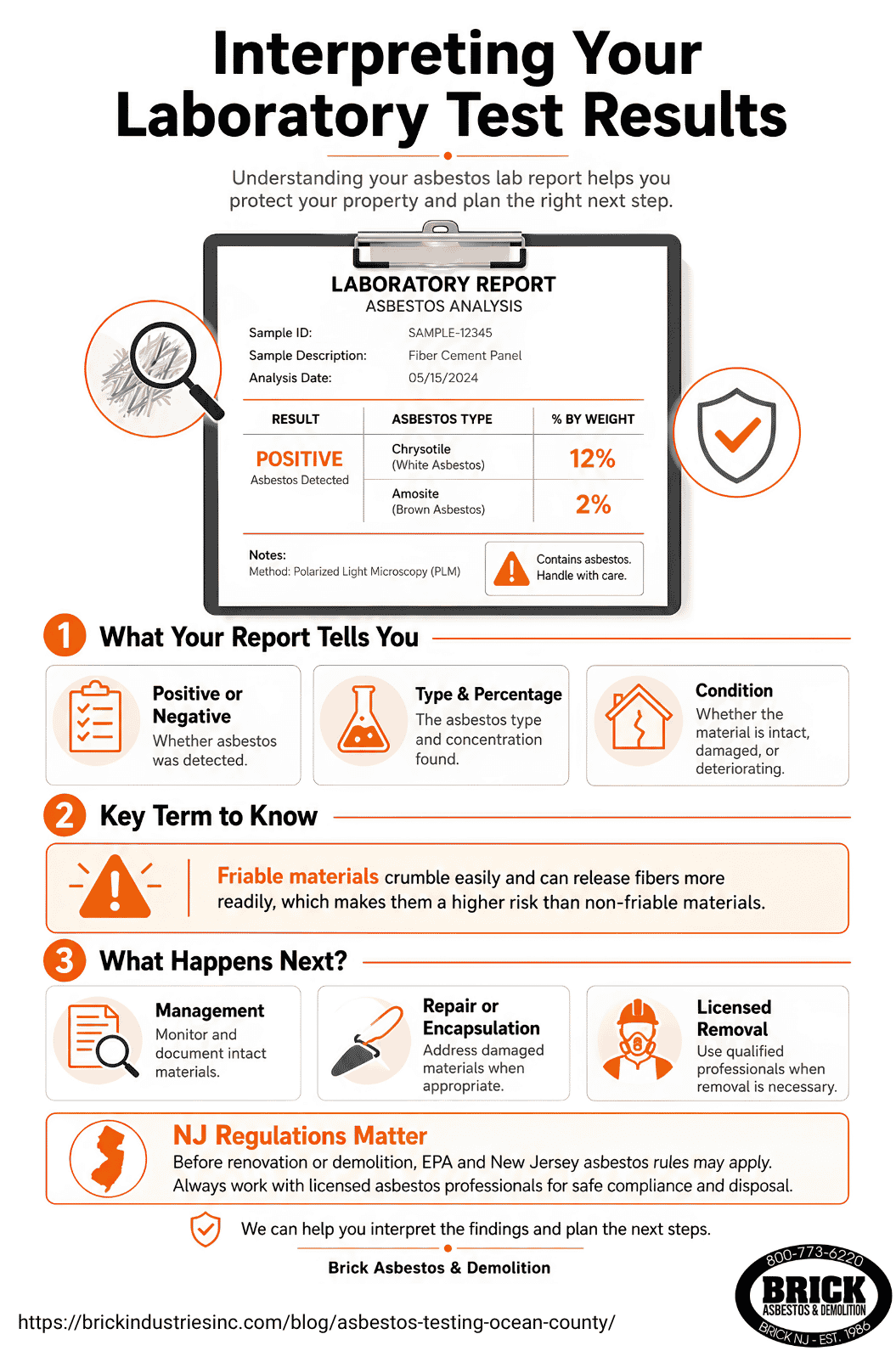
Receiving your asbestos testing results is a pivotal moment. Understanding the report is crucial for protecting your property and its occupants. We can help you interpret the findings and plan the next steps.
Your report will detail the presence, type, and condition (friable vs. non-friable) of any asbestos-containing materials. Friable materials crumble easily and release fibers, posing a higher risk. This information will lead to a clear action plan for management, repair, or removal.
Interpreting Your Report and Navigating NJ Regulations
An asbestos test report will indicate:
- Positive vs. Negative Results: Whether asbestos was detected.
- Asbestos Type and Percentage: The specific type and concentration.
- Condition Assessment: The material’s current state (intact, damaged, or deteriorating).
Managing asbestos involves navigating federal and state laws. The EPA’s NESHAP regulations require inspections for pre-1991 buildings before renovation or demolition. New Jersey has its own strict laws enforced by the NJDOH and DOLWD, mandating licensed contractors for abatement and proper disposal. DIY testing and removal are illegal and dangerous. Learn more on the EPA’s Asbestos laws and regulations page.
Why Professional Abatement is Your Only Safe Option
If testing confirms asbestos, especially if it’s damaged, professional abatement is the only safe and legal option. Never attempt DIY removal due to:
- Health Dangers: Inhaling microscopic fibers can cause mesothelioma, lung cancer, and asbestosis.
- Contamination Risks: Disturbing asbestos without proper containment can spread fibers throughout your property, creating a larger, more expensive problem.
- Legal Liabilities: New Jersey law requires a DOLWD-licensed contractor for all abatement work. DIY removal can lead to significant fines.
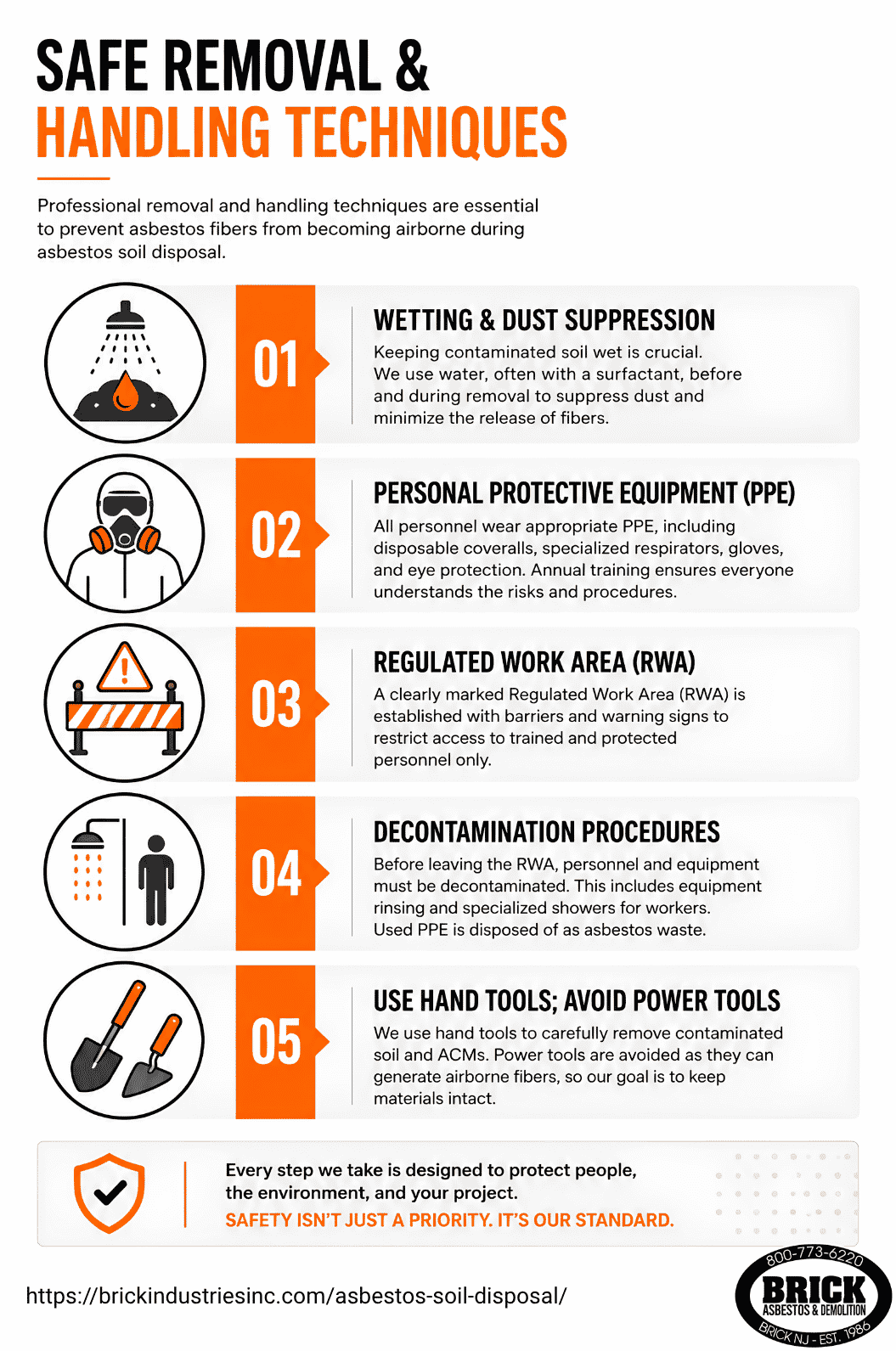
Professional abatement techniques include:
- Encapsulation: Sealing the material to prevent fiber release.
- Enclosure: Building an airtight barrier around the material.
- Removal: The complete and controlled removal of asbestos, often necessary for damaged materials or during renovations.
Our team serves Brick and Ocean County, adhering to the strictest safety protocols.
Key Takeaways: Safe Asbestos Management in New Jersey
Dealing with potential environmental hazards can feel overwhelming, but taking a systematic, professional approach ensures your renovation project stays entirely safe and legally compliant.
- Never Assume by Sight: Asbestos fibers are microscopic. The only definitive way to confirm its presence is through a Polarized Light Microscopy (PLM) analysis performed by an NVLAP-accredited laboratory.
- Separate Testing From Abatement: To ensure an completely unbiased assessment, always use an independent inspector for the initial testing rather than relying on an all-in-one quote from an enforcement or removal crew.
- Verify Licensing Prior to Work: New Jersey state regulations are strict. Anyone collecting samples or performing mitigation must hold active certifications from the NJ Department of Health (NJDOH) and the Department of Labor and Workforce Development (DOLWD).
- Avoid DIY Risks entirely: Disturbing friable asbestos materials releases toxic fibers into your home’s air supply. DIY removal is highly dangerous, illegal under state law, and can result in severe municipal penalties.
Need a verified, compliant assessment for your property?
Whether you are planning a residential renovation or handling a property transaction in Brick, Toms River, or the surrounding communities, safety cannot be compromised.
Ready to get started? Reach out to the certified experts at Brick Industries, Inc. today to secure your testing and regulatory compliance.

Recent Articles
Abatement Pro’s Cheat Sheet to Identifying Asbestos in Insulation
What Happens to Concrete After Demolition? Recycling, Reuse, and Disposal in NJ