
The Art of Containment: Ensuring Safety with Negative Pressure
Why Negative Pressure Containment is Non-Negotiable for Safe Abatement
Negative pressure containment is a critical safety technique that prevents hazardous airborne particles—like asbestos fibers, mold spores, or construction dust—from escaping a work area. By creating a controlled environment where air flows into a sealed zone rather than out of it, this method protects workers, building occupants, and the surrounding environment from dangerous exposure.
Quick Answer: Setting Up Asbestos Containment
- Construct a sealed barrier around the work area using polyethylene sheeting
- Seal all HVAC vents to prevent contamination of the building’s air system
- Install a HEPA-filtered air scrubber inside the containment zone
- Exhaust filtered air through ductwork to the outside
- Monitor pressure continuously using a manometer to maintain at least -0.02″ water column
- Verify containment with smoke tests before beginning work
If you’ve ever walked past a hospital room marked “Isolation” or seen plastic sheeting sealing off a construction zone in an old building, you’ve witnessed negative pressure containment in action. The average hospital operates for 40 to 100 years—requiring constant renovation and maintenance. During these projects, disturbed materials can release airborne particles that pose serious health risks to vulnerable patients.
The same principle applies to asbestos abatement, mold remediation, and hazardous material removal in residential, commercial, and industrial properties. Whether you’re preparing an old factory for redevelopment or removing asbestos from a home in New Jersey, negative pressure containment isn’t just a best practice—it’s often a legal requirement.
This technique works by creating a “vacuum effect.” More air exits the sealed work area than enters it, ensuring that any airborne contaminants are pulled inward and filtered through HEPA systems before being safely exhausted outside. This prevents dangerous fibers from migrating into occupied spaces, neighboring properties, or the outdoor environment._compressed.png?alt=media&token=d09f0e86-1f38-465b-a60e-93306a55abf7 "user-inserted")
What is Negative Pressure Containment and Why is it Essential?
At Brick Asbestos & Demolition, we understand that safety isn’t just a buzzword; it’s the foundation of everything we do. In our line of work—from Asbestos Removal to commercial demolition in New Jersey, New York, and Pennsylvania—we frequently encounter hazardous materials like asbestos, lead, and mold. This is where negative pressure containment becomes not just important, but absolutely essential.
Simply put, negative pressure containment is a method where we create an environment where the air pressure inside a designated work area is slightly lower than the pressure outside of it. Imagine blowing air into a balloon (positive pressure) versus sucking air out of a sealed bag (negative pressure). In our case, we’re creating that “sucking” effect within the containment zone. This ensures that if there are any tiny gaps, cracks, or openings in our sealed barrier, air (and any contaminants it carries) will always flow into the work area, never out. It’s like an invisible shield, keeping dangerous particles locked down.
Why is this so crucial? Let’s consider a few scenarios:
- Asbestos Abatement: When we’re removing asbestos-containing materials from an old home in Point Pleasant or a commercial building in Sayreville, microscopic asbestos fibers can become airborne. These fibers, if inhaled, pose severe long-term health risks. Negative pressure containment ensures these deadly fibers stay within our sealed work zone, protecting our team and preventing Asbestos Contamination of your property and the surrounding environment.
- Mold Remediation: Mold spores are another common airborne hazard, especially after water damage. During remediation, disturbing mold can release millions of spores that can trigger allergic reactions, asthma attacks, or other respiratory issues. Our containment strategies ensure these spores are captured and removed, not spread throughout your property.
- Hazardous Material Removal: Beyond asbestos and mold, many demolition or renovation projects can expose us to other hazardous dusts and chemicals. Negative pressure containment is a universal strategy to control these airborne threats, safeguarding public health and environmental integrity.
The core principle behind how negative pressure containment works is neat in its simplicity: we move more air out of the contained space than we allow to enter naturally. This creates a subtle vacuum. The air that is allowed to exit is first passed through specialized filters, often High-Efficiency Particulate Air (HEPA) filters, which can efficiently capture airborne particles as small as 0.3 microns. This means even the tiniest asbestos fibers or mold spores don’t stand a chance of escaping our containment.
This technique isn’t just for hazardous material removal. In healthcare settings, for example, negative pressure rooms (often called isolation rooms) are vital for preventing the spread of highly contagious airborne diseases like tuberculosis, measles, chickenpox, SARS, MERS, and COVID-19. Hospitals, many of which are decades old, constantly undergo renovations. These projects can stir up dust, spores, and pathogens. Negative pressure containment is crucial in these environments to protect vulnerable patients and staff from these construction-related airborne dangers.
Whether it’s protecting patients in a hospital or ensuring a safe asbestos removal project in Monmouth County, the basic idea is the same: control the airflow to keep the bad stuff in and the good stuff out (or, in our case, filter it before it leaves!).
A Step-by-Step Guide to Establishing Negative Pressure Containment
Establishing a secure negative pressure containment area is a meticulous process, but it’s a non-negotiable part of our commitment to safety and compliance during any Abatement Process. We follow a precise, step-by-step approach to create an effective barrier against airborne hazards.
Step 1: Plan and Prepare the Area
Before a single piece of plastic is unrolled, thorough planning is paramount. This initial phase sets the stage for a successful and safe containment.
- Site Assessment: We conduct a detailed inspection of the work area and surrounding spaces. This involves identifying all potential air leakage points, such as windows, doors, electrical outlets, light fixtures, and utility penetrations.
- Determine Airflow Needs: To effectively create negative pressure, we need to know how much air needs to be moved. We calculate the volume of the containment area (length x width x height) and then determine the required air changes per hour (ACH). For instance, if local regulations (like those in Minnesota, which often set benchmarks for the industry) require at least 4 ACH for containment, we use that as our baseline. You can use an air change calculator to help with this. This calculation informs the number and size of portable air scrubbers we’ll need.
- Strategic Layout: We plan the placement of equipment, entry/exit points (airlocks), and exhaust routes. The goal is to ensure optimal airflow within the containment zone, directing contaminants towards the air filtration devices.
Step 2: Construct the Physical Barrier
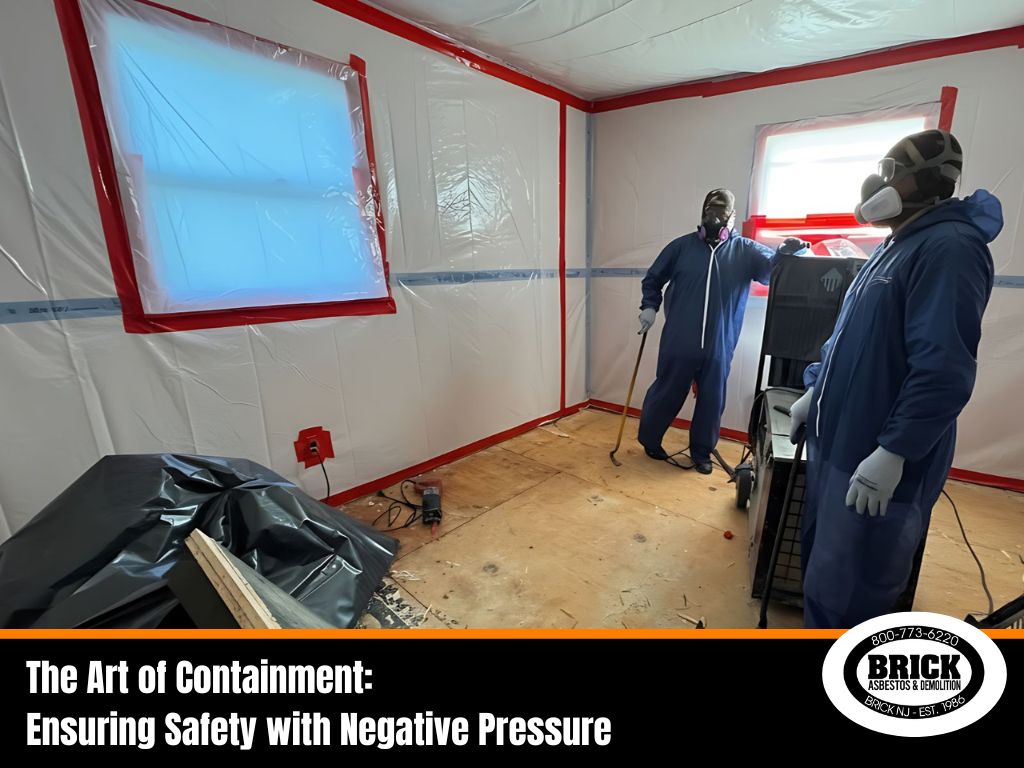
This is where the physical containment takes shape, creating a sealed enclosure around the work zone._compressed.png?alt=media&token=d944c1da-8a62-436a-ba5d-339ab83a07b2 "user-inserted")
- Barrier Material: We use durable, heavy-duty polyethylene sheeting (typically 6-mil thick) to construct the walls, ceiling, and floor of the containment. This material is robust enough to withstand the work and create an effective seal.
- Sealing All Edges: Every seam, every edge where the poly sheeting meets a wall, floor, or ceiling, must be carefully sealed. We use specialized, aggressive adhesive tape to ensure an airtight seal, eliminating any potential leaks. Effective containment requires precision and attention to detail, not just hanging plastic sheets.
- Airlock Entrance/Exit: For projects requiring personnel entry and exit, we construct a multi-chamber airlock. This typically involves two or more chambers separated by zippered doorways. This design acts as a buffer zone, preventing contaminated air from escaping when workers or materials enter or leave the primary work area. It also serves as a decontamination unit for personnel and equipment.
- Structural Integrity: We ensure the barrier is securely fastened to prevent accidental breaches or collapse, especially when negative pressure is applied.
Step 3: Isolate the HVAC System
One of the most critical steps in preventing cross-contamination is isolating the building’s heating, ventilation, and air conditioning (HVAC) system from the containment zone.
- Seal HVAC Vents: All supply and return air vents located within the containment area must be completely sealed off. We use heavy-duty preservation tape to cover these vents, ensuring no gaps remain. This prevents hazardous particles from being drawn into the building’s central HVAC system and distributed to unaffected areas.
- Isolate Ducts: In some cases, it may be necessary to physically isolate sections of ductwork that pass through or near the containment area. Our goal is to prevent any potential pathway for contaminants to escape the sealed zone and protect building occupants. We double-check the seals on all HVAC penetrations after taping to ensure no gaps remain.
Step 4: Install and Vent the Air Filtration Device
This step introduces the active component of negative pressure containment – the equipment that cleans the air and creates the pressure differential.
- Portable Air Scrubbers (PAS): We strategically place portable air scrubbers (PAS) inside the containment area. These powerful units draw air from the contaminated space.
- HEPA Filtration: The air drawn into the PAS units passes through a series of filters, culminating in a HEPA filter. As mentioned, HEPA filters are incredibly efficient, capturing 99.97% of airborne particles as small as 0.3 microns, including asbestos fibers, mold spores, and other hazardous particulates. Using certified HEPA filters is essential for capturing fine particles and contaminants.
- Strategic Placement for Optimal Airflow: We position the air scrubbers to maximize airflow patterns within the containment, drawing air from the furthest points towards the exhaust.
- Venting Filtered Air: The thoroughly filtered air is then exhausted out of the containment zone through ductwork. The ideal scenario is to vent this air to the outside of the building, away from any air intakes, windows, or pedestrian traffic. If outdoor exhaust isn’t feasible (which can happen in complex urban environments in NYC or older buildings in Philadelphia), the air may be recirculated indoors only after passing through a verified HEPA filtration system, and often with additional air quality monitoring. Exhausting into HVAC returns, restroom exhaust systems, or other shared ducts is generally prohibited to prevent recontamination.
Essential Equipment and Monitoring for Success
The integrity of any negative pressure containment project hinges on using the right equipment and diligently monitoring its effectiveness. This isn’t a “set it and forget it” operation; it requires continuous vigilance.
The Toolkit for Negative Pressure Containment
To create and maintain a robust negative pressure containment system, we rely on a specialized toolkit:
- Portable Air Scrubbers (PAS): These are the workhorses of our system, designed to pull air from the containment zone and pass it through advanced filtration. Examples of professional-grade units include the HEPA-AIRE® PAS series and PREDATOR® models, which are built for demanding environments.
- HEPA Filters: Integral to the air scrubbers, these filters are our primary defense against airborne contaminants. They must be regularly inspected and replaced to maintain their 99.97% efficiency rating for particles 0.3 microns and larger.
- Manometer or Portable Differential Pressure Monitor: This crucial device measures the pressure difference between the inside and outside of the containment zone. A portable differential pressure monitor provides accurate, real-time readings, ensuring we maintain the required negative pressure.
- Polyethylene Sheeting: High-quality, durable poly sheeting (typically 6-mil) forms the physical barrier of the containment.
- Specialized Adhesive Tape: Heavy-duty, high-tack tape is essential for sealing all seams, edges, and penetrations in the poly sheeting to prevent air leakage.
- Airlock/Decontamination Unit: Often pre-fabricated or constructed on-site with poly sheeting and zippers, this unit provides a safe entry/exit point and a space for personnel and equipment decontamination.
- Smoke Pens or Tubes: These tools release a harmless puff of smoke that allows us to visually verify airflow direction at entry points and around seams, confirming that air is being drawn into the containment.
- Ducting: Flexible or rigid ducting is used to route the filtered air from the air scrubbers to the designated exhaust point.
How to Monitor and Verify Negative Pressure
Maintaining the correct pressure differential is key to the effectiveness of negative pressure containment. We employ several methods for continuous monitoring and verification:
- Continuous Electronic Pressure Monitoring: This is our most precise method. We install digital manometers or differential pressure monitors that provide continuous, real-time readings of the pressure difference. These devices often have alarms that will sound if the pressure deviates from the set parameters, alerting our team to potential breaches or equipment malfunctions. Visual pressure monitors are installed outside containment areas to continuously verify pressurization.
- Smoke/Tissue Test: This simple yet effective visual test is performed at entry points, particularly at the bottom of zippered doorways or antechamber entrances. We hold a smoke pen or a strip of tissue paper at the opening. If the smoke or tissue is drawn into the containment zone, it confirms negative pressure. If it pushes outwards, there’s a problem. This test is quick and easy to perform regularly throughout the day.
- Regular Visual Checks: Our supervisors and technicians constantly inspect the physical barrier for any tears, dislodged tape, or compromised seals. Even a small breach can compromise the entire containment.
- Documentation: We carefully log all pressure readings, equipment checks, and any deviations or corrective actions taken. This documentation is crucial for compliance and demonstrates our adherence to safety protocols. For instance, the CDC provides extensive Guidelines for Environmental Infection Control that underscore the importance of such monitoring practices.
Best practices dictate that monitoring is not a one-time event. For critical applications, like a patient isolation room, negative pressure should be checked daily when in use. For our asbestos and demolition projects, our team continuously monitors the containment throughout the duration of the work to ensure the safety of everyone involved.
Navigating Regulations and Best Practices
When dealing with hazardous materials like asbestos, compliance with regulations isn’t just about avoiding fines; it’s about protecting lives. We operate strictly within federal, state, and local guidelines for negative pressure containment in New Jersey, New York, and Pennsylvania.
Understanding the Required Pressure and Airflow
Regulatory bodies and industry standards provide clear benchmarks for effective negative pressure containment:
- Pressure Differential: The most critical measurement is the pressure differential, typically expressed in “inches of water column” (in H₂O or ” WC). This measures the slight vacuum inside the containment. While specific numbers can vary by jurisdiction and hazard level, common recommendations include:
- The Facilities Guidelines Institute (FGI) recommends a negative pressure differential of ≥ –0.03” in H₂O in high-risk areas.
- The Association for Professionals in Infection Control and Epidemiology (APIC) suggests –0.02 to –0.04” in H₂O.
- For asbestos abatement, regulations often specify a minimum negative pressure of –0.02” in H₂O. For example, Minnesota regulations require a negative pressure of -0.02 inches of water column (‘ WC) for containment, which serves as a widely recognized industry standard.
- Air Changes Per Hour (ACH): This refers to how many times the entire volume of air within the containment zone is replaced with filtered air in one hour. This ensures constant air purification and helps maintain the pressure differential.
- A minimum of 4 air changes per hour is a common requirement in many regulations, including Minnesota’s.
- However, if achieving the target negative pressure (e.g., -0.02″ WC) proves challenging, some regulations allow for an alternative. For instance, if -0.02″ WC cannot be achieved, an alternative of 6 air changes per hour may be used, provided certain conditions are met, such as carefully documenting the reasons for the deviation and continuously monitoring.
- HEPA Filtration: The use of HEPA filters is universally mandated for exhaust air from hazardous material containment. These filters are capable of capturing 99.97% of particles 0.3 microns or larger. Understanding What a HEPA filter is is fundamental to effective containment.
We adhere strictly to all applicable NJ Asbestos Regulations, as well as those in NY and PA, which often align with these industry benchmarks to ensure maximum safety. Our team is trained to understand and implement these requirements precisely.
Negative vs. Positive Pressure Environments
While we’ve focused on negative pressure containment, it’s helpful to understand its counterpart: positive pressure. Both use controlled airflow to achieve specific safety goals, but they work in opposite ways.
Let’s start.

Recent Articles
From Foundation to Dust: Your Complete Guide to Building Demolition
Steel Demolition: Techniques, Safety, and What You Need to Know