

The Complete Guide to Asbestos Soil Disposal

Why Contaminated Soil Demands Immediate Attention
Asbestos soil disposal is a critical process requiring strict adherence to regulations to protect health and avoid legal penalties. If you’ve found asbestos-contaminated soil on your property, here’s what you need to know:
Quick Answer: How to Dispose of Asbestos Soil Safely
- Stop all work immediately – Do not disturb the contaminated soil.
- Contact a licensed professional – Only certified contractors can legally handle friable asbestos or quantities over 100 square feet.
- Follow proper containment – Keep soil wet, use 6-mil plastic double-bagging, and label all materials.
- Use licensed transporters – Asbestos waste must be transported by certified hazardous waste haulers.
- Dispose at approved facilities – Only EPA-licensed landfills can accept asbestos-contaminated soil.
- Maintain documentation – Keep manifests and disposal records for legal compliance.
Key Fact: Asbestos is a known human carcinogen. When soil containing asbestos is disturbed, microscopic fibers become airborne and can cause mesothelioma, asbestosis, and lung cancer, often decades after exposure.
Asbestos contaminates soil through demolition debris, improper dumping, or even naturally occurring deposits (NOA) disturbed by excavation. The finding of asbestos can halt a project, especially in New Jersey, where properties built before the 1980s often contain asbestos-containing materials (ACMs). For homeowners, developers, and property managers, understanding the legally mandated disposal process is essential.
Why Professional Help Matters
Improper disposal carries severe penalties, including fines and imprisonment, and poses serious health risks. Federal (NESHAP, OSHA) and state regulations set strict requirements for removal, transport, and disposal, often requiring certified transporters for quantities over 50 pounds. The complexity extends to the type of asbestos: friable (easily crumbled and highly dangerous) and non-friable (bonded). Friable asbestos always requires licensed professionals, and non-friable asbestos can become friable when disturbed, increasing the risk.
This guide focuses strictly on the identification, health risks, and regulatory protocols for safely handling asbestos-contaminated earth. For interior property testing, see our Professional Asbestos Testing guide. For structural abatement procedures, read our Asbestos Removal Process breakdown. For immediate commercial or residential debris removal, visit our Contaminated Soil & Concrete Disposal services page.
Understanding Asbestos in Soil: Risks and Identification
What is Asbestos-Contaminated Soil?
Asbestos-contaminated soil contains asbestos fibers or asbestos-containing materials (ACMs), making it a hazardous substance that requires careful management. Contamination occurs in several ways:
- Naturally Occurring Asbestos (NOA): In some regions, asbestos exists naturally in rock and soil. While undisturbed NOA is low-risk, activities like construction or excavation can release dangerous fibers into the air.
- Breakdown of Building Materials: Used in thousands of products before 1990 (e.g., insulation, tiles, cement, roofing), these materials degrade over time. Damaged or weathered ACMs release fibers into the surrounding soil.
- Improper Dumping: Illegal dumping of ACMs in unequipped landfills or on undeveloped land is a major source of contamination. As these materials break down, they release asbestos. It is illegal to dispose of asbestos in domestic garbage, re-use, or dump it.
- Legacy Industrial Sites: Former manufacturing plants, power stations, or mines that used asbestos often have contaminated soil from industrial waste.
Understanding the difference between friable and non-friable asbestos is crucial. Friable asbestos can be crumbled by hand, easily releasing dangerous fibers. Non-friable asbestos is bonded within a material like cement but can become friable if damaged, which often happens when mixed with soil.
To dig deeper into the nature of asbestos contamination, visit our page on Asbestos Contamination.
Health Risks and Identification Methods
The health risks of asbestos are severe. As a known carcinogen, its airborne fibers can be inhaled and lodge in the lungs, causing life-threatening diseases decades later, including:
- Mesothelioma: A rare and aggressive cancer affecting the lining of the lungs, abdomen, or heart.
- Asbestosis: A chronic lung disease causing scarring of lung tissue and shortness of breath.
- Lung Cancer: Asbestos exposure significantly increases the risk of developing lung cancer.
There is no safe level of asbestos exposure. The primary risk is inhaling airborne fibers. Damaged ACMs in soil are more likely to release fibers than intact materials, making contaminated soil a significant threat.
Proper identification is essential to managing these risks:
- Visual Inspection (with Limitations): While large fragments of ACMs may be visible, this method is unreliable for detecting microscopic fibers. The absence of visible debris does not mean the soil is safe.
- Professional Assessment: A certified professional must assess asbestos in soil. They have the expertise to evaluate contamination, distinguish between friable and non-friable materials, and interpret lab results.
- Soil Sampling and Laboratory Analysis: The only definitive method is professional soil sampling and analysis by an accredited lab using techniques like polarized light microscopy (PLM). This testing is precise enough to meet strict regulatory limits.
If you suspect asbestos in your soil, seek professional help immediately. Our team offers comprehensive Professional Asbestos Testing to accurately assess your situation. For more technical details, review the EPA framework for asbestos site investigation.
Navigating the Safe Removal of Contaminated Dirt
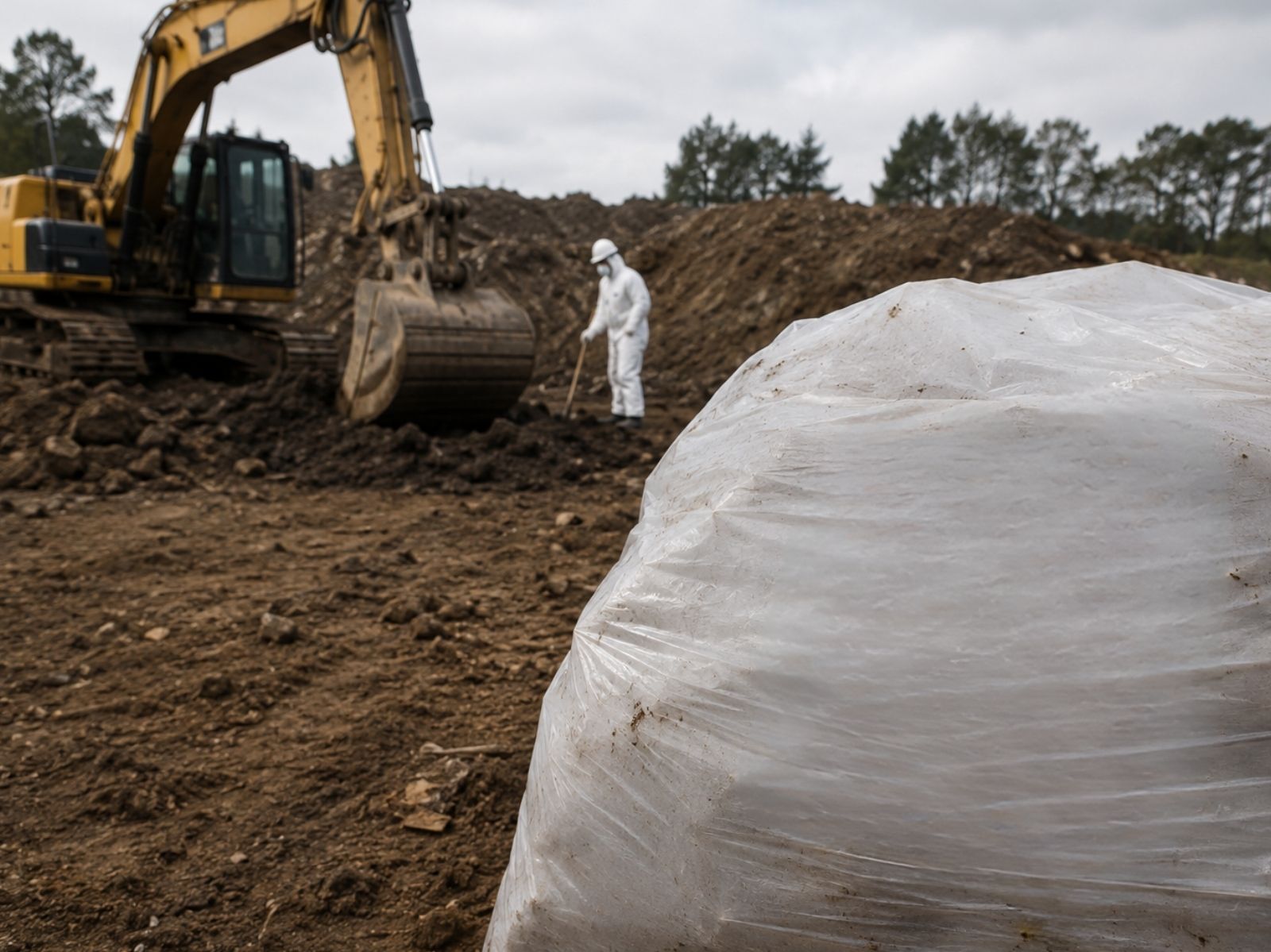
Once asbestos is identified in soil, safe and compliant disposal is the next critical step. This complex process requires navigating federal and state regulations, following strict safety protocols, and maintaining thorough documentation.
Key Environmental Regulations and Legal Frameworks
The legal framework for asbestos soil disposal protects public health and the environment. Key guidelines include:
- Federal Regulations: The U.S. Environmental Protection Agency (EPA) and the Occupational Safety and Health Administration (OSHA) set the primary rules.
- EPA NESHAP: These rules (40 CFR Part 61, Subpart M) govern asbestos removal and disposal to prevent air contamination.
- OSHA Standards: OSHA regulations protect workers by setting exposure limits (0.1 f/cc over 8 hours), requiring PPE, mandating training, and establishing regulated work areas.
- State-Specific Rules (New Jersey): New Jersey has its own stringent rules for handling and disposing of asbestos, which is classified as hazardous waste. These laws often require specific licensing for contractors and transporters.
- Local Ordinances and Permits: Some municipalities in New Jersey may require additional notifications, permits, or inspections for asbestos abatement and soil removal.
- Hazardous Waste Manifests: Shipments of asbestos-contaminated soil must typically be accompanied by a hazardous waste manifest that documents the generator, transporter, quantity, and final disposal facility.
- Legal Penalties for Non-Compliance: Failure to comply results in severe penalties, including heavy fines and imprisonment. It is illegal to dispose of asbestos in domestic garbage, reuse, or dump it.
Safe Removal and Handling Techniques
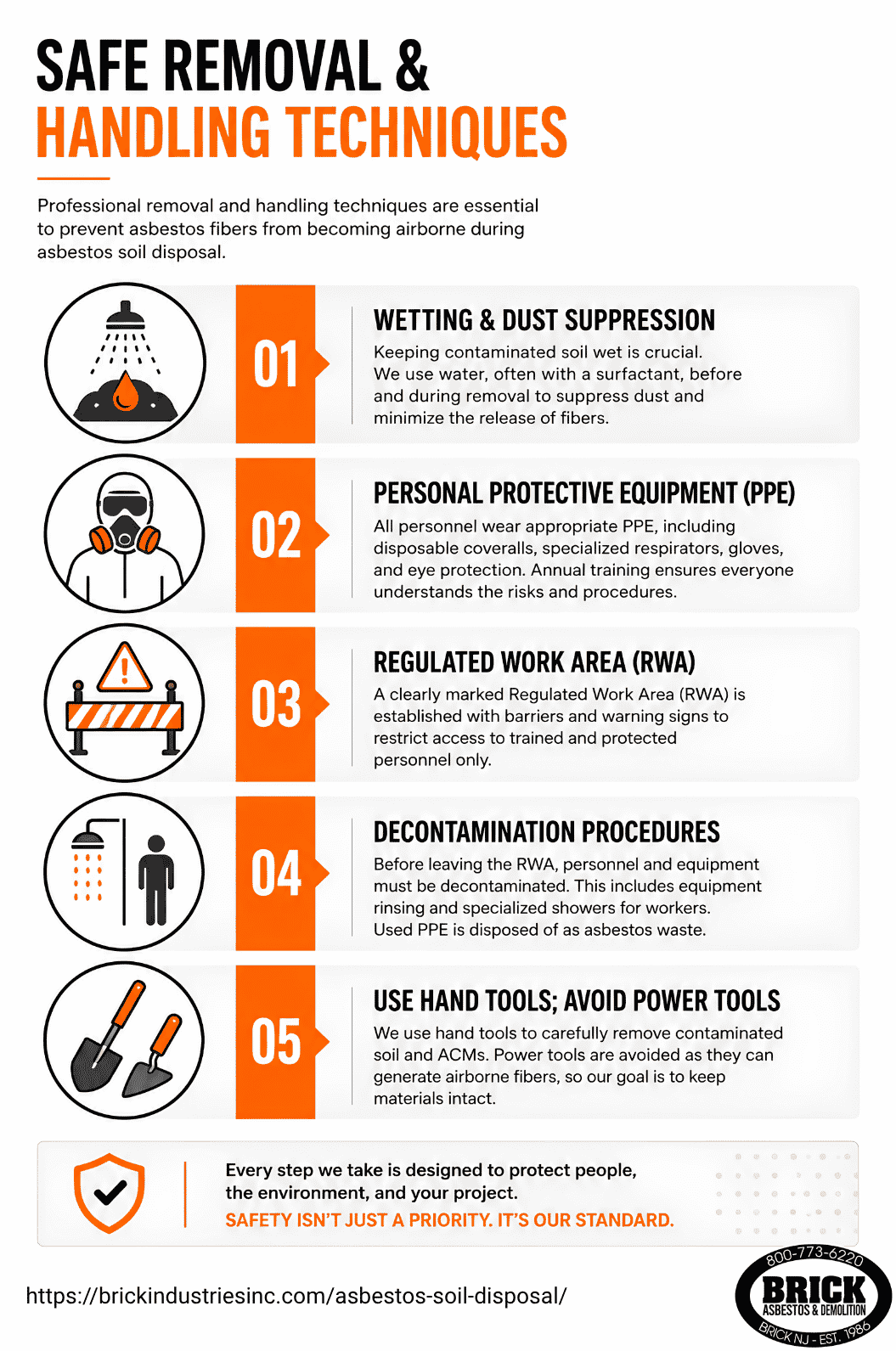
Professional removal and handling techniques are essential to prevent asbestos fibers from becoming airborne during asbestos soil disposal:
- Wetting Methods and Dust Suppression: Keeping the contaminated soil wet is crucial. We use water, often with a surfactant, before and during removal to suppress dust and minimize the release of fibers.
- Personal Protective Equipment (PPE): All personnel must wear appropriate PPE, including disposable coveralls, specialized respirators, gloves, and eye protection. Annual training ensures everyone understands the risks and procedures.
- Regulated Work Area: A clearly marked Regulated Work Area (RWA) is established with barriers and warning signs to restrict access to trained and protected personnel only.
- Decontamination Procedures: Before leaving the RWA, personnel and equipment must be decontaminated. This includes equipment rinsing and specialized showers for workers. Used PPE is disposed of as asbestos waste.
- Using Hand Tools; Avoiding Power Tools: We use hand tools to carefully remove contaminated soil and ACMs. Power tools are avoided as they can generate airborne fibers, so our goal is to keep materials intact.

You can learn more about the precise steps we take to ensure safety and compliance on our Asbestos Removal Process page.
Final Transport and Professional Abatement Protocols
The final stages of asbestos soil disposal—transport and landfilling—are just as critical as removal. A professional team ensures these steps are handled safely and in strict compliance with all regulations.
Transport and Landfill Requirements for Asbestos Soil Disposal
Transporting asbestos-contaminated soil is a highly regulated process.
- Leak-Proof Containers, Double-Bagging, and Labeling: All asbestos waste must be sealed in leak-proof containers. This often involves double-bagging in 6-mil plastic, sealing with tape, and applying clear warning labels. For large jobs, we use specialized lined bins.
- Licensed Hazardous Waste Transporters and Manifest Tracking: Asbestos waste must be transported by a certified hazardous waste hauler in a covered, leak-proof vehicle. A legal manifest tracks the waste from your site to the landfill, ensuring a proper chain of custody and providing proof of disposal.
- Approved Landfill Criteria and Immediate Burial Procedures: Waste must go to an EPA-licensed landfill equipped to handle asbestos. These facilities require advance notice and follow strict protocols. The waste is immediately buried under at least 6 inches of non-asbestos material, with a final cover of at least 36 inches, to safely isolate it. The locations are mapped to prevent future disturbance.
Key Takeaways: Managing Contaminated Soil Safely
Finding hazardous materials buried on your property can bring construction to a screeching halt, but handling it correctly prevents long-term legal liability and devastating health impacts.
- Stop Work Immediately: The moment you suspect contamination, halt all excavation. Disturbing the earth releases microscopic, carcinogenic fibers into the air.
- Never Attempt DIY Removal: Federal and state laws strictly prohibit unlicensed individuals from handling friable asbestos or large quantities of non-friable asbestos. There is no safe level of exposure.
- Containment is Critical: Professional abatement requires keeping the site wet to suppress dust, using 6-mil plastic double-bagging for leak-proof containment, and establishing a Regulated Work Area (RWA).
- Demand a Paper Trail: Proper disposal isn’t just about getting it off your property; it is about proving it was handled legally. Always ensure you receive a hazardous waste manifest tracking your materials to an EPA-licensed landfill.
Need immediate assistance with contaminated soil on your job site?
If you have uncovered suspected asbestos materials during an excavation or demolition project in New Jersey, our certified experts are ready to secure the site.
Contact Brick Industries, Inc. today for compliant soil testing and emergency disposal services.

Recent Articles
What Happens to Concrete After Demolition? Recycling, Reuse, and Disposal in NJ
Cheat Sheet to Identifying Asbestos in Insulation