

Rapid Response: Handling Asbestos Contamination in a Crisis

Why Immediate Action Is Critical After Asbestos Exposure
Emergency asbestos cleanup requires immediate professional intervention to protect health and ensure regulatory compliance. Here’s what you need to know right now:
Quick Response Guide for Emergency Asbestos Situations:
- Stop all work immediately and evacuate the affected area
- Do not touch, sweep, or vacuum any dust or debris
- Contact state or local health authorities if a damaged building contains asbestos
- Call a licensed asbestos abatement professional for testing and removal
- Keep the area wet if material must be disturbed (professionals only)
- Never attempt DIY removal – even brief exposure can be harmful
- Vacate the property until professional cleanup is complete
Following a natural disaster like a fire, flood, or severe storm, homeowners often need to act fast. But speed cannot compromise safety. Many older homes, particularly those built before 1975, contain significant amounts of asbestos in materials like insulation, floor tiles, popcorn ceilings, and pipe wrapping. When these materials are damaged, asbestos fibers become airborne and pose serious health risks, including mesothelioma, lung cancer, and asbestosis.
These diseases often develop 20 to 60 years after exposure, and even short exposure can be harmful.
Federal regulations don’t pause for emergencies. The EPA’s Asbestos NESHAP (National Emission Standards for Hazardous Air Pollutants) still applies during catastrophic events. While specific provisions exist for emergency renovations and government-ordered demolitions, the core requirements remain: proper notification, trained supervisors on-site, adequate wetting of materials, and compliant disposal at approved landfills.
I’m Eric Plackis, President of Brick Industries, Inc., a state and federally licensed asbestos abatement contractor with decades of experience, including volunteer emergency asbestos cleanup work with Samaritan’s Purse during disaster relief efforts. Throughout my career, I’ve helped homeowners, municipalities, and property managers steer the complex challenges of emergency asbestos cleanup while maintaining strict compliance with EPA, OSHA, and NJ DEP regulations.
This guide focuses on immediate crisis response, safety protocols, and regulations for handling damaged asbestos after a disaster. For routine facility compliance, see our Commercial Asbestos Removal guide. For identifying undisturbed hazards, read our guide on Asbestos in Old Homes.
Understanding the Immediate Threat: Asbestos in Emergency Situations
When disaster strikes, the immediate aftermath can be chaotic and overwhelming. Our homes and communities, designed to protect us, can suddenly become sources of hidden danger, especially if they contain asbestos. This naturally occurring mineral, once lauded for its fire-retardant and insulating properties, becomes a serious health hazard when disturbed, releasing microscopic fibers into the air.
In emergencies whether from fires, floods, or violent storms, buildings can suffer significant damage. Walls might crumble, roofs collapse, and insulation can become exposed. This damage can disturb asbestos-containing materials (ACMs), turning a stable, encapsulated hazard into an immediate threat. For example, a fire can cause asbestos to become friable (easily crumbled), releasing fibers. Flooding can dislodge and break down materials, while wind and impact damage from storms can shatter asbestos products.
The primary health risks associated with asbestos exposure are severe and often don’t manifest until decades after initial contact. Diseases like mesothelioma (a rare and aggressive cancer affecting the lining of the lungs, abdomen, or heart), lung cancer, and asbestosis (a chronic lung disease causing shortness of breath and scarring) typically develop 20 to 60 years after exposure.
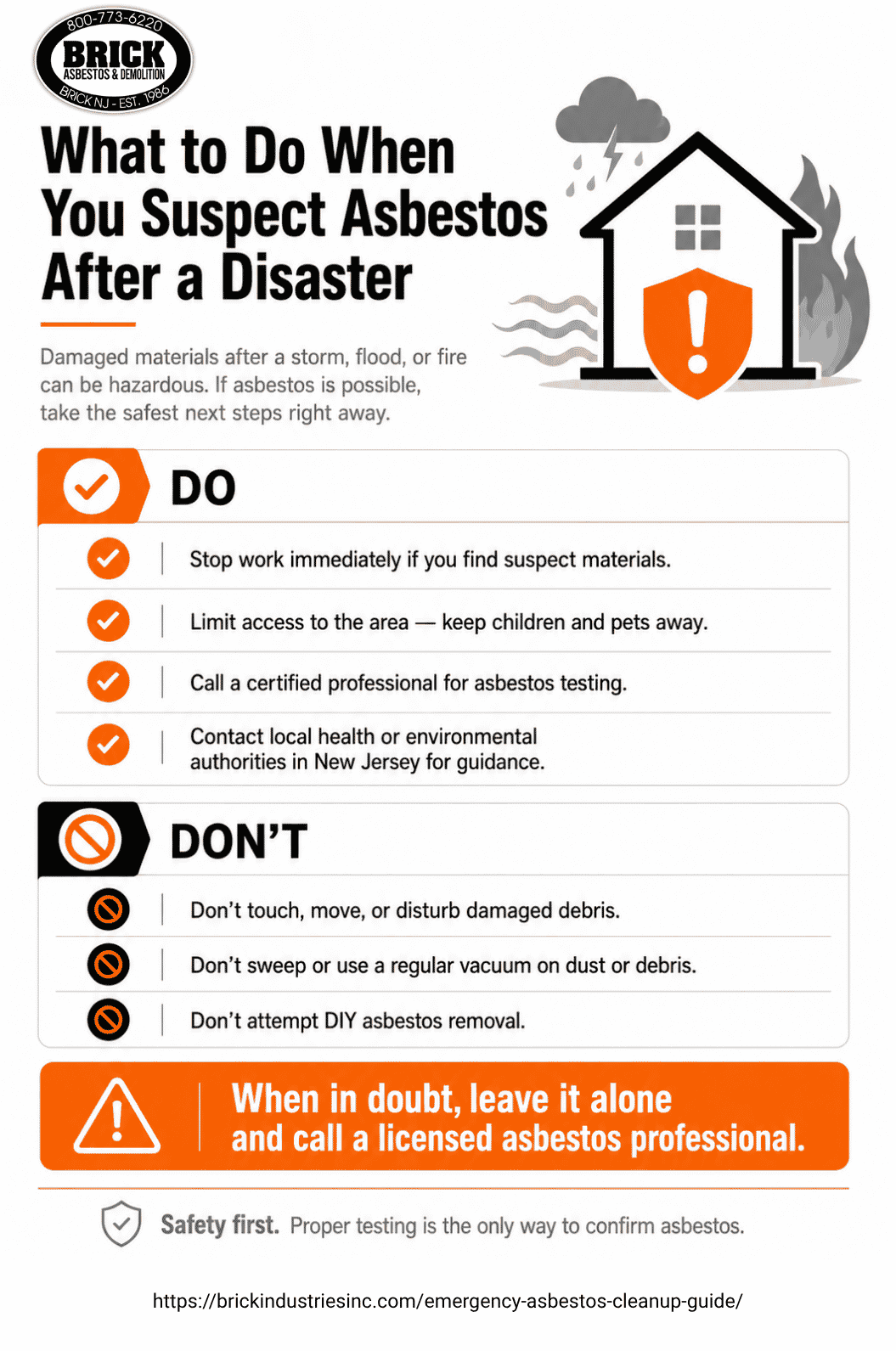
What to Do When You Suspect Asbestos After a Disaster
Encountering damaged building materials after a disaster can be unsettling, especially if you suspect asbestos. Your safety, and the safety of your family and neighbors, is the top priority. Here’s a concise list of Do’s and Don’ts to guide your immediate actions:
- DO stop work immediately. If you’re involved in initial cleanup efforts and encounter suspect materials, cease all activity that could disturb them.
- DO limit access to the area. Keep people, especially children and pets, away from the damaged materials to prevent further exposure.
- DO call a professional for Asbestos Testing. Visual inspection alone cannot confirm the presence of asbestos. Only certified professionals can safely collect samples and have them analyzed.
- DO contact local authorities. Reach out to your local health department or environmental protection agency for guidance and resources specific to New Jersey.
- DON’T touch or disturb debris. Avoid handling any damaged materials that might contain asbestos. Leave them exactly as they are.
- DON’T sweep or vacuum dust. Sweeping or using a regular vacuum cleaner will only stir up and spread asbestos fibers, making the problem worse.
- DON’T attempt removal yourself. Attempting DIY removal without proper training, equipment, and licensing is extremely dangerous and illegal. Asbestos management has been exclusively entrusted to licensed contractors and handlers since a federal mandate in 1988.
Common Asbestos-Containing Materials in Damaged Homes
Here are some common asbestos-containing materials (ACMs) frequently encountered in damaged properties across New Jersey:
- Popcorn Ceilings (Textured Paints): Often found in homes built between the 1950s and 1980s. These finishes can release fibers if scraped, water-damaged, or crumbling.
- Pipe Insulation: Used to insulate heating and hot water pipes, it often appears as a grayish-white, fibrous material wrapped around pipes.
- Siding and Roofing Shingles: Asbestos-cement products were durable and fire-resistant. Damaged or broken shingles can release fibers into the air and onto the ground.
- Vinyl Floor Tiles and Adhesives: Many older resilient floor tiles and the black mastic adhesives used to install them contain asbestos. Breaking or tearing these tiles is a common way to release fibers.
- Joint Compounds and Plaster: Used to finish drywall seams and walls, these materials can contain asbestos that becomes airborne during demolition or renovation.
You cannot tell if a material contains asbestos just by looking at it. Professional testing is always required to confirm its presence.
The Professional Emergency Asbestos Cleanup Process
When disaster strikes and asbestos is suspected or confirmed, the situation demands a rapid, professional, and compliant response. This is where the expertise of licensed asbestos abatement professionals becomes indispensable. The goal during an emergency asbestos cleanup is always two-fold: to protect human health and to prevent further environmental contamination.
Unlike routine cleanup, emergency asbestos cleanup often occurs under challenging conditions – damaged structures, compromised utilities, and the pressure of time. This amplifies the need for meticulous planning and execution by certified experts.
The U.S. Environmental Protection Agency (EPA) provides crucial Guidance for Catastrophic Emergency Situations Involving Asbestos, which outlines the federal regulations and best practices that guide these operations. This guidance emphasizes that federal asbestos regulations, including the Asbestos NESHAP, still apply during catastrophic events.
The approach integrates these federal guidelines with strict New Jersey state and local regulations to deliver a comprehensive and safe abatement solution. This involves creating a controlled environment using containment barriers, maintaining negative air pressure within the work zone, employing specialized wetting methods to keep fibers from becoming airborne, and utilizing HEPA-filtered vacuums for thorough cleaning. All removed materials are then carefully prepared for disposal in approved landfills that meet NESHAP requirements.
Key Steps in an Emergency Asbestos Cleanup
An effective emergency asbestos cleanup is a highly structured process, even amidst the chaos of a disaster. Here are the key steps followed to help ensure safety and compliance:
- Site Assessment and Planning: A thorough assessment of the damaged area identifies asbestos-containing materials (ACMs), determines their condition, and defines the safest removal strategy.
- Containment Setup: Critical containment zones are established using thick polyethylene sheeting, creating a barrier around the affected area to prevent asbestos fibers from spreading.
- Air Filtration and Negative Air Pressure: High-efficiency particulate air (HEPA) filtered negative air machines are deployed within the containment. These machines continuously filter the air and help keep asbestos fibers from escaping.
- Safe Removal Techniques: Licensed professionals, equipped with full personal protective equipment (PPE), carefully remove ACMs. This often involves wetting the materials to suppress dust and minimize fiber release.
- Decontamination of Work Area: Once ACMs are removed, the entire work area, including all surfaces and equipment, is carefully cleaned using HEPA vacuums and wet wiping.
- Proper Bagging and Labeling: Removed asbestos materials are double-bagged in thick, leak-tight plastic bags, sealed, and clearly labeled with appropriate asbestos warning signs.
- Transportation and Disposal: The sealed and labeled asbestos waste is transported in covered, lined vehicles to a licensed and approved landfill facility in New Jersey that is specifically authorized to accept asbestos waste.
- Final Air Clearance Testing: After cleanup and decontamination are complete, an independent third party can conduct air monitoring to confirm that airborne asbestos fiber levels are below regulatory limits.
To understand the comprehensive process, you can learn more about the full abatement process.
Regulations Governing Emergency Asbestos Cleanup
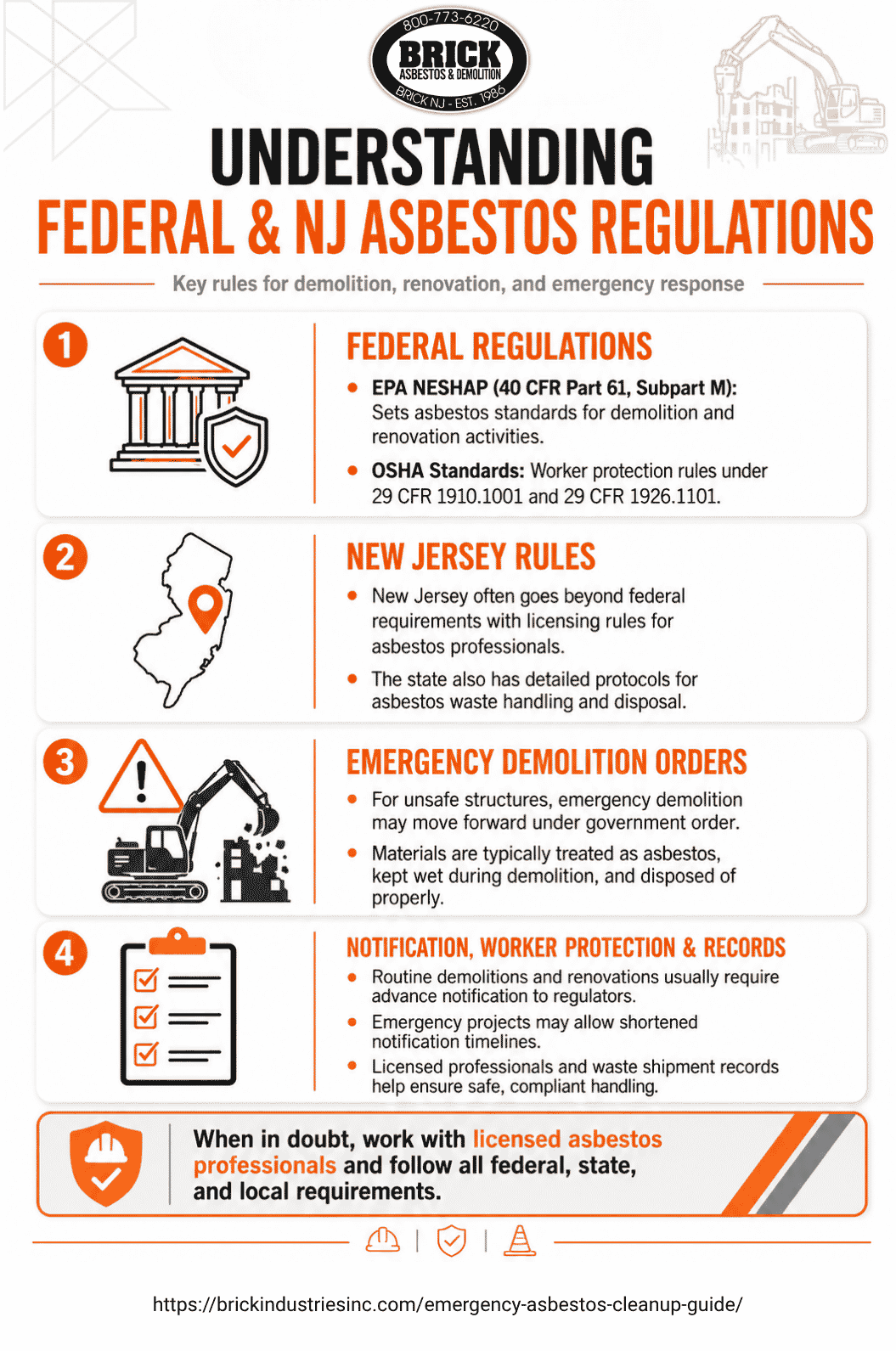
The regulatory landscape for asbestos is complex, but it’s designed to protect public health and the environment. In New Jersey, work is performed under a framework of federal, state, and local regulations.
Federal Regulations:
- EPA National Emission Standards for Hazardous Air Pollutants (NESHAP): The EPA’s NESHAP (40 CFR Part 61, Subpart M) sets standards for asbestos during demolition and renovation activities.
- OSHA Standards: The Occupational Safety and Health Administration (OSHA) sets standards for worker protection (29 CFR 1910.1001 for general industry and 29 CFR 1926.1101 for construction).
New Jersey State and Local Rules:
New Jersey has its own set of regulations that often go beyond federal requirements. These include specific licensing requirements for asbestos professionals and detailed protocols for waste handling and disposal. You can find more information about the state’s guidelines in the article on NJ Asbestos Regulations.
Emergency Demolition Orders: In catastrophic situations, state or local government agencies may issue emergency demolition orders for structurally unsound buildings. While these demolitions might be exempt from prior asbestos inspection and removal, all material is typically treated as asbestos, kept wet during demolition, and disposed of properly.
Notification Requirements: For routine demolitions or renovations, notification to the EPA or relevant state agency is typically required in advance. For emergency renovations and government-ordered demolitions, this timeline can be shortened so regulators are aware and can oversee compliance.
Worker Protection and Records: Trained professionals hold the necessary licenses to handle asbestos safely. Accurate waste shipment records track the movement of asbestos-containing waste from the generation site to the approved disposal landfill.
Asbestos Repair vs. Full Removal
When dealing with asbestos-containing materials, particularly after an emergency, one common question is whether to repair or remove the material. Both options have their place, depending on the condition, location, and potential for future disturbance of the asbestos.
| Feature | Asbestos Repair (Encapsulation/Enclosure) | Asbestos Removal (Abatement) |
|---|---|---|
| Description | Sealing or covering the asbestos material to help prevent fiber release. Encapsulation uses a sealant; enclosure builds a barrier around it. | The physical removal of asbestos-containing materials from the structure. |
| When to Use | Best for materials that are in good condition, not damaged, and unlikely to be disturbed in the future. | Necessary for damaged or deteriorating materials, or when major renovations or demolition are planned. |
| Pros | Generally less expensive and less disruptive than removal. Leaves the asbestos in place but contained. | A long-term solution that removes the asbestos hazard from the work area. |
| Cons | Not a permanent solution. The asbestos remains and requires periodic inspection. The covering can be damaged. | More expensive and disruptive. Often requires vacating the property during the process. |
| Cost | More cost-effective in the short term for materials in good condition. | Higher upfront cost but can reduce the need for future monitoring and additional work. |
Key Takeaways: Responding to an Asbestos Emergency
When a fire, flood, or storm damages your property, the risk of airborne asbestos fibers turns a structural issue into a severe health hazard. Moving quickly is important, but moving safely is mandatory.
- Stop and Evacuate: Never touch, sweep, or attempt to vacuum suspected asbestos debris. Evacuate the area to prevent fiber inhalation.
- DIY Removal is Dangerous and Illegal: Handling damaged asbestos requires specialized training, full PPE, and HEPA-filtered containment systems.
- Regulations Do Not Pause: Federal guidelines from the EPA (NESHAP) and OSHA, as well as strict New Jersey state regulations, still apply during catastrophe recovery.
- Professional Clearance is Required: An emergency cleanup is not complete until an independent third party conducts final air clearance testing to ensure the environment is safe to re-occupy.
Need immediate assistance with damaged asbestos? If a disaster has compromised asbestos-containing materials in your New Jersey home or business, our licensed experts are ready to respond.
Contact Brick Industries, Inc. today for emergency asbestos testing and compliant cleanup.

Recent Articles
What Happens to Concrete After Demolition? Recycling, Reuse, and Disposal in NJ
Cheat Sheet to Identifying Asbestos in Insulation